
Introduction
Every concrete road built by Aspire Enterprises in India is, in effect, a contract with a code. The code that sits at the center of that contract for construction is IRC:15. It tells a contractor how the pavement should be built, how the materials should behave, and what good workmanship actually means on site.
For a contractor, IRC:15 is not background reading. It is the document where audits, quality checks, and disputes are settled. Understanding it is the difference between a pavement that is accepted on the first inspection and one that triggers rework.
This guide explains what IRC:15 is, what it covers, and the key areas of compliance a highway contractor needs to have firmly in hand in 2026. The aim is practical clarity, not a line-by-line reproduction of the code.
What Is IRC:15?
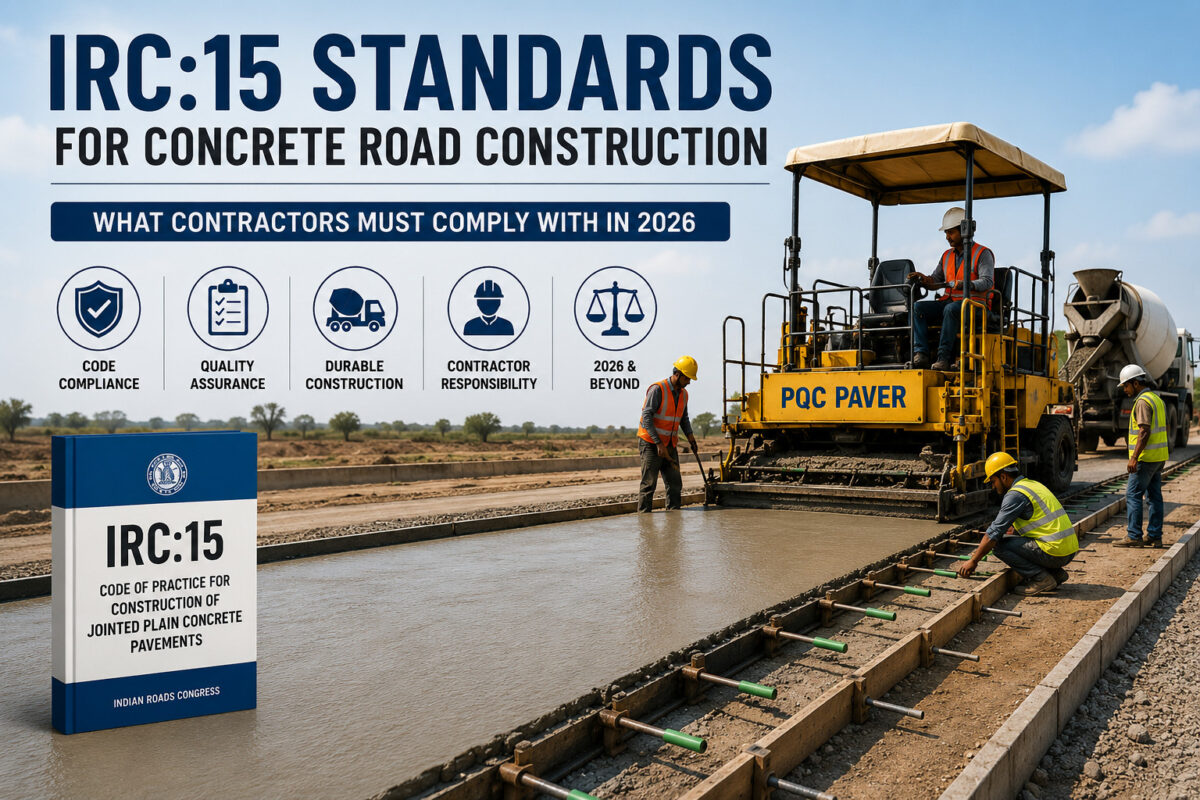
IRC:15 is the Indian Roads Congress code of practice for the construction of concrete roads. Over its more recent revisions the title has been updated to reflect its focus on the construction of jointed plain concrete pavements, which is the standard form of rigid pavement on Indian highways.
The code sets out standard specifications and good practice for building the concrete pavement: the materials, the sub base, the joints, the paving, the finishing, the curing, and the quality controls. It is the construction companion to the design side of rigid pavements.
IRC:15 has been revised several times, with well known editions including those of 2002, 2011 and 2017. Construction practice, materials, and equipment have all moved on across those revisions. Because codes are updated periodically, the single most important compliance habit is to confirm and work to the latest published edition of IRC:15 for your project, and to read it alongside the project specification, since contract documents can add or tighten requirements.
How IRC:15 Fits With Other Standards
IRC:15 does not work alone. A contractor on a concrete road project is usually working to a small family of documents at the same time.
| Document | Main Role |
| IRC:15 | Construction of jointed plain concrete pavements |
| IRC:58 | Design of plain jointed rigid pavements |
| MoRTH Specifications | Specifications for road and bridge works, including cement concrete pavement |
| BIS standards | Material specifications and test methods for cement, aggregates, steel and more |
| ASTM standards | Test methods referenced where specified in the contract |
In simple terms, IRC:58 covers how the pavement is designed, IRC:15 covers how it is built, and the MoRTH specifications and BIS standards fill in the detailed material and workmanship requirements. The project specification ties them together and can be stricter than any of them. Compliance means satisfying all of the documents that apply, not just one.
Key Compliance Areas Under IRC:15
The code touches the whole concrete pavement, but a contractor can think of compliance in a set of practical areas.
Materials:
Cement, coarse and fine aggregates, water, steel, and admixtures all have to meet specified requirements and be tested and approved. Aggregates must be well graded, hard, and clean. Steel for dowel bars and tie bars must be the correct type, with plain round bars for dowels and deformed bars for tie bars. Material acceptance is the foundation of every other check.
Concrete mix and strength:
The PQC mix must be designed to meet the specified strength, which for rigid pavement, is governed by flexural strength. Mix design, trial mixes, and ongoing testing during production all form part of compliance. Workability has to suit the paving method.
Sub base and dry lean concrete:
The dry lean concrete base must be built to the specified thickness, strength, and surface tolerance, and accepted before paving. A sound, uniform DLC is a precondition for a sound slab.
Separation membrane:
An impermeable separation membrane is laid between the DLC and the PQC slab. It must be the specified material and thickness, laid flat with correct overlaps. This debonding layer protects the crack control behaviour of the slab.
Joints, dowels and tie bars:
Joint layout, spacing, and type must follow the design. Dowel bars at transverse joints and tie bars at longitudinal joints must be the correct size, spacing, and alignment. Expansion joints need their compressible joint board and dowel caps. Joint construction is one of the most scrutinised areas of compliance.
Paving, compaction and finishing:
The slab must be placed, compacted, and finished to the specified thickness and surface tolerance. Compaction must remove voids without causing segregation. The surface must receive the specified texture for skid resistance.
Curing:
Curing must begin promptly and continue for the full specified period, commonly around 14 days, keeping the concrete continuously moist. Curing failures are a frequent and avoidable cause of non compliance.
Joint cutting and sealing:
Contraction joints must be saw cut within the correct timing window and to the specified depth. Joints must then be cleaned, primed, and sealed with the specified materials.
Tolerances and testing:
Thickness, level, surface regularity, and strength all have acceptance tolerances. The contractor must test, record, and demonstrate that the work falls within them.
Step by Step: Building IRC:15 Compliance Into a Project
1. Obtain the current code and specification: Confirm the latest IRC:15 edition and read it with the project specification and design.
2. Get materials approved early: Test and approve cement, aggregates, steel, and admixtures before they are needed in the pour.
3. Finalise and trial the mix: Complete mix design and trial mixes so the PQC meets the specified flexural strength.
4. Build and accept the DLC: Construct the dry lean concrete base to the specified thickness and tolerance and have it formally accepted.
5. Set out joints from the design: Mark the joint layout and spacing exactly as designed before fabricating dowel and tie-bar assemblies.
6. Prepare for the pour: Have the separation membrane, dowel and tie bar assemblies, grade control, and curing materials ready.
7. Pave to specification: Place, compact, finish, and texture the slab to the specified thickness and surface tolerance.
8. Cure fully: Begin curing promptly and maintain it for the full period.
9. Cut and seal joints correctly: Saw joints within the timing window and to depth, then clean, prime, and seal them.
10. Test and document: Record material tests, strength results, thickness, and levels, and keep the quality records that demonstrate compliance.
Common Compliance Mistakes to Avoid
Working with an outdated edition: Codes are revised. Using a superseded edition can mean missing current requirements.
Reading the code without the specification: The project specification can be stricter, and it governs alongside the code.
Weak material control: Untested or poorly stored materials undermine every later check.
A substandard DLC: A base built outside tolerance compromises the slab above it.
Wrong membrane or poor laying: A non-specified or badly laid separation membrane weakens crack control.
Joint and dowel errors: Wrong spacing, size, or alignment of dowels and tie bars is a common audit finding.
Short or late curing: One of the most frequent and most avoidable non-compliances.
Joints cut outside the timing window: Cutting too early or too late causes defects.
Poor record keeping: Without test records and measurements, compliant work cannot be demonstrated.
Best Practices for IRC-15 Compliance
- Always work to the latest published edition of IRC:15 and confirm it at project start.
- Read the code together with IRC:58, the MoRTH specifications, BIS standards, and the project specification.
- Approve all materials before they are required on site.
- Treat the acceptance of each layer as a formal hold point.
- Set out joints precisely and check dowel and tie bar alignment before every pour.
- Begin curing promptly and run it for the full specified period.
- Cut and seal joints within the correct timing and to the specified depth.
- Keep complete, organised quality records throughout the project.
- Remember that standards and tolerances can vary by project, so the contract documents always govern.
Conclusion
IRC:15 is the rulebook that turns a rigid pavement design into a real road. It covers materials, the base, the joints, the paving, the curing, and the testing, and it is the document your work will be measured against. Knowing it well is simply part of being a competent concrete road contractor.
The practical message for 2026 is straightforward. Work to the latest published edition, read it together with IRC:58, the MoRTH specifications, BIS standards, and your project specification, and build compliance into the project from material approval onwards. Treat each layer acceptance as a hold point, cure fully, cut joints on time, and keep good records. Standards and tolerances can vary by project, so let the contract documents govern, and a concrete road built that way will pass inspection and perform for decades.
Frequently Asked Questions
What is IRC:15?
IRC:15 is the Indian Roads Congress code of practice for the construction of concrete roads, focused on jointed plain concrete pavements. It sets out standard specifications and good practice for building rigid pavements in India.
What is the latest edition of IRC-15?
IRC:15 has been revised several times, with editions including 2002, 2011 and 2017. Because the code is updated periodically, contractors should always confirm and work to the latest published edition for their project.
What is the difference between IRC:15 and IRC:58?
IRC:58 covers the design of plain jointed rigid pavements, while IRC:15 covers their construction. IRC:58 tells you what to build, and IRC:15 tells you how to build it correctly.
What does IRC:15 cover?
IRC:15 covers materials, the concrete mix, the dry lean concrete base, the separation membrane, joints, dowel and tie bars, paving and finishing, curing, joint cutting and sealing, and the tolerances and testing for concrete pavement construction.
Do contractors have to follow IRC:15 and the project specification?
Yes. The project specification governs alongside the code and can be stricter. Compliance means satisfying IRC:15, the related standards, and the project specification together.
Which standards work alongside IRC:15?
IRC:15 is used with IRC:58 for design, the MoRTH specifications for road and bridge works, BIS standards for materials and testing, and ASTM standards where the contract references them.
What are the most common IRC:15 non-compliances?
Frequent issues include weak material control, a substandard DLC, a wrong or poorly laid separation membrane, dowel and joint errors, short or late curing, and joints cut outside the correct timing window.
How long should concrete pavement be cured under good practice?
Concrete pavement is generally cured continuously for about 14 days, kept moist throughout, although the contractor should always follow the period stated in the project specification.
Related Blogs
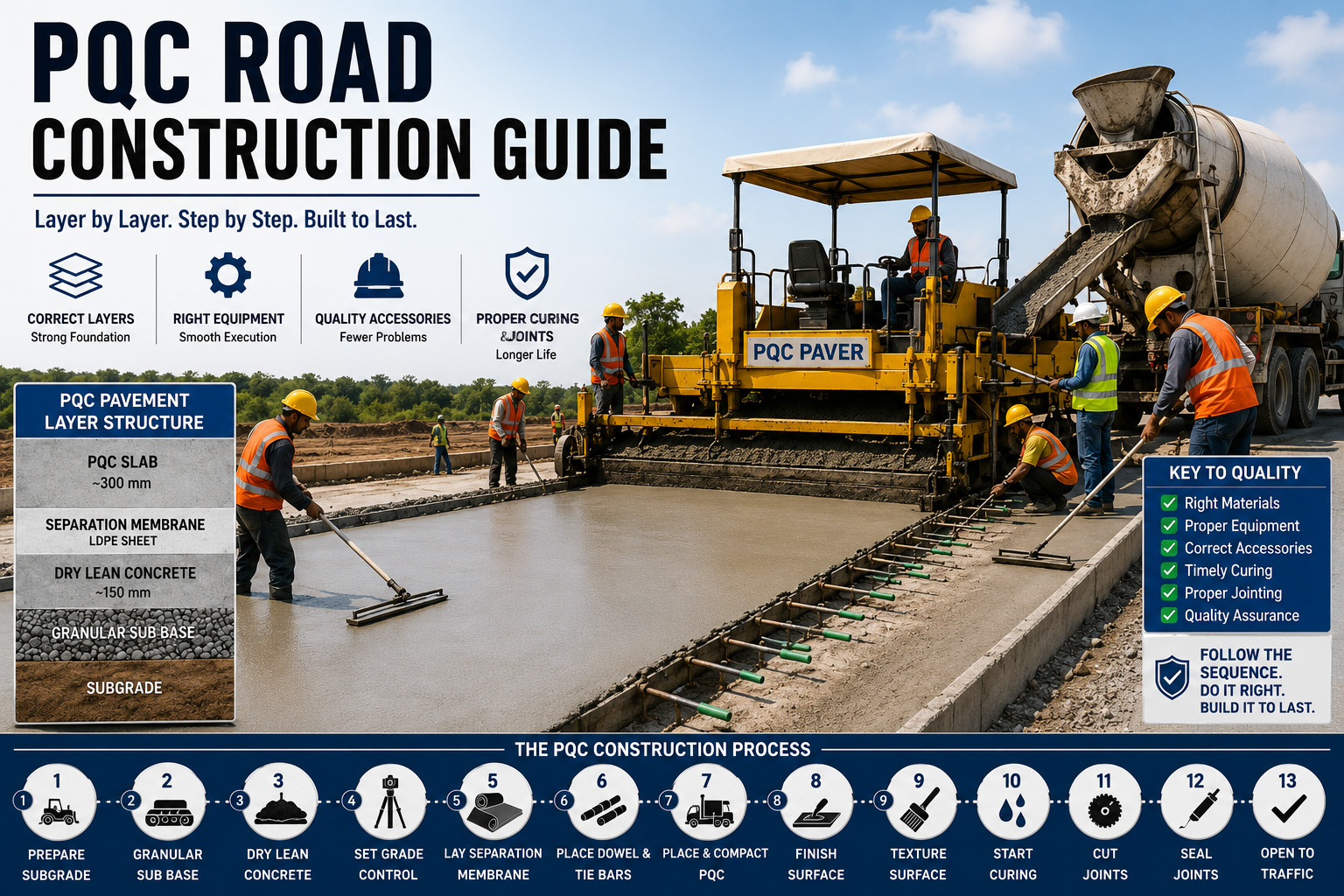
PQC Road Construction Step by Step: Materials, Equipment, and Accessories Required
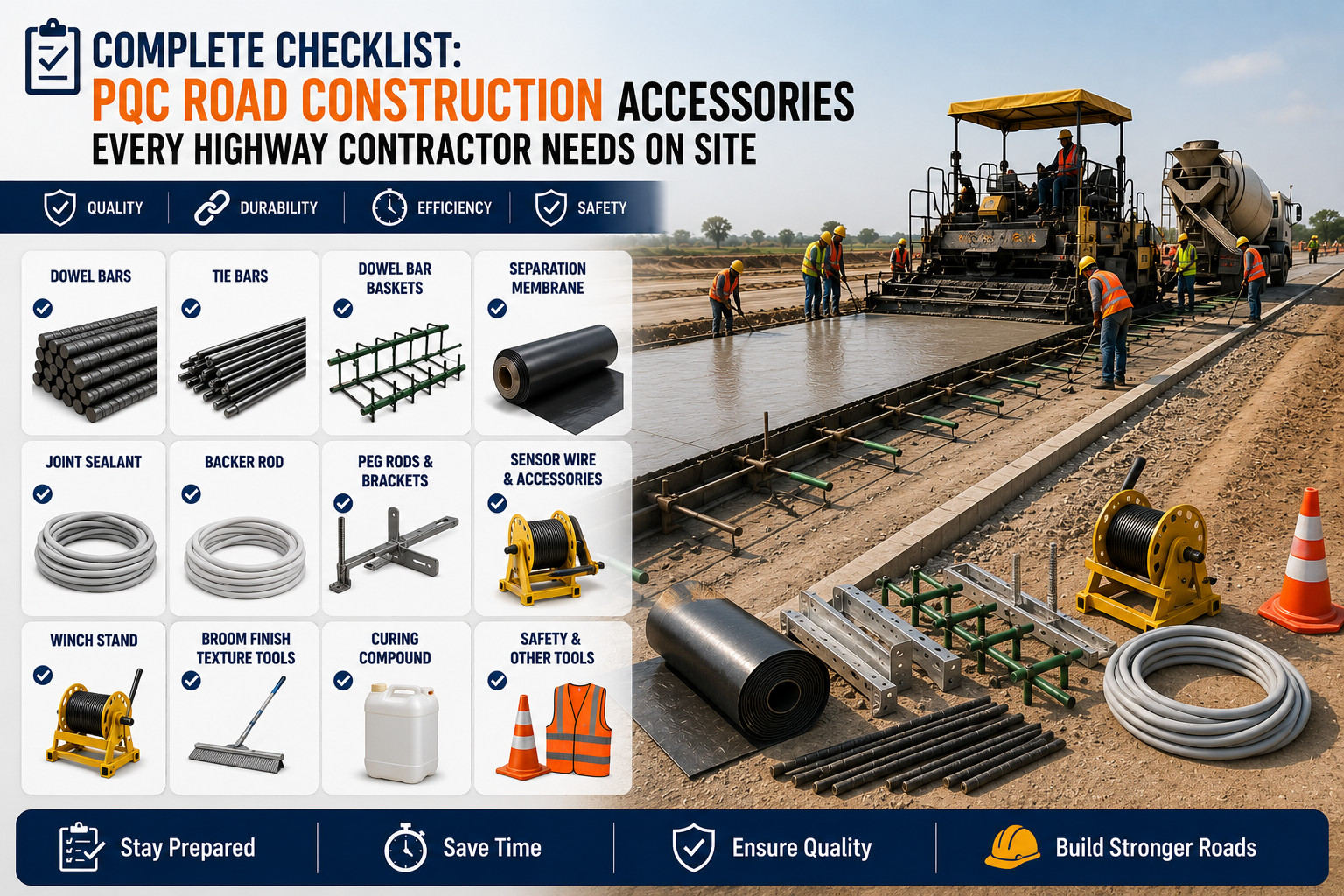
Complete Checklist: PQC Road Construction Accessories Every Highway Contractor Needs on Site
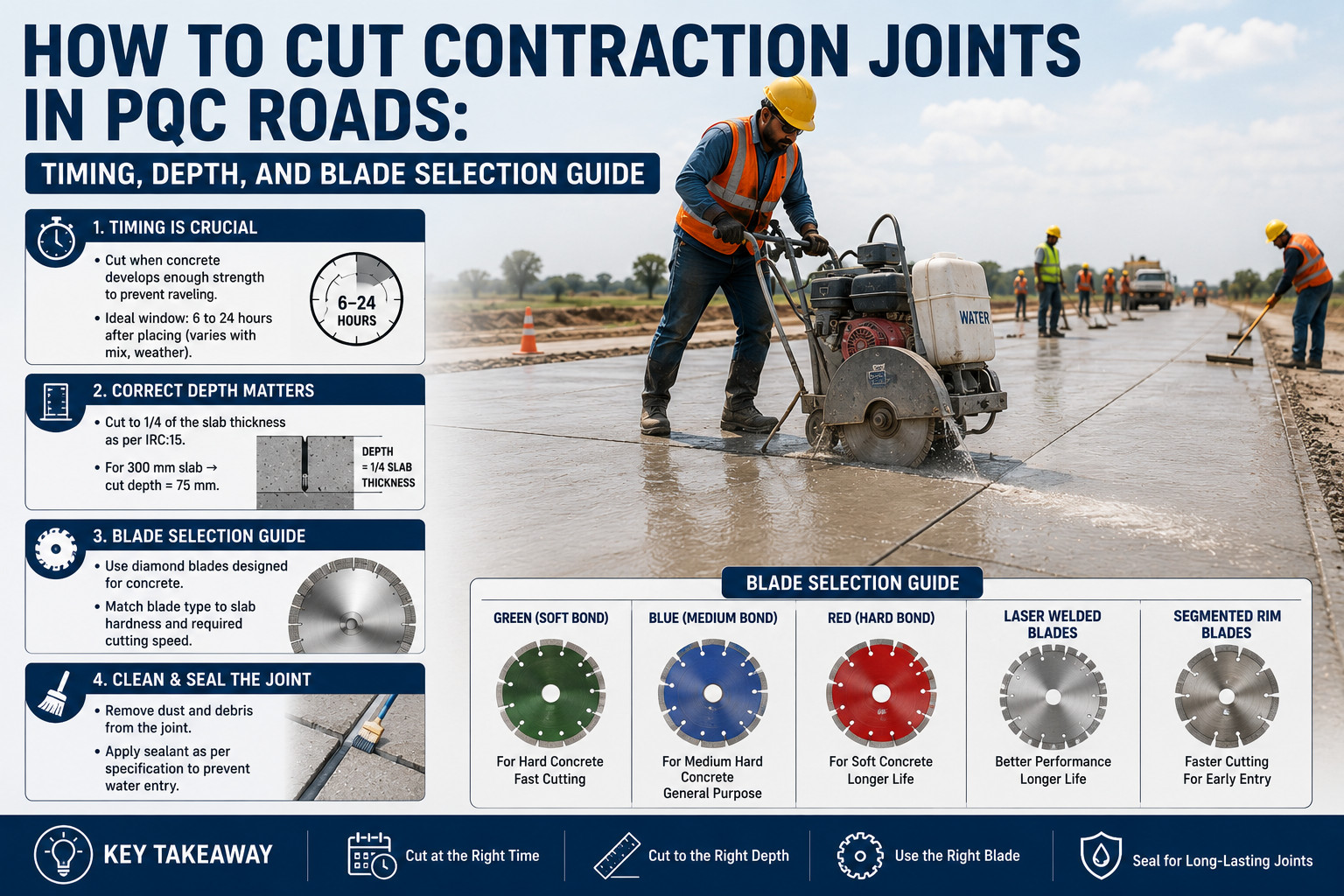
How to Cut Contraction Joints in PQC Roads: Timing, Depth, and Blade Selection Guide