Caution Tape Manufacturer and Supplier in India
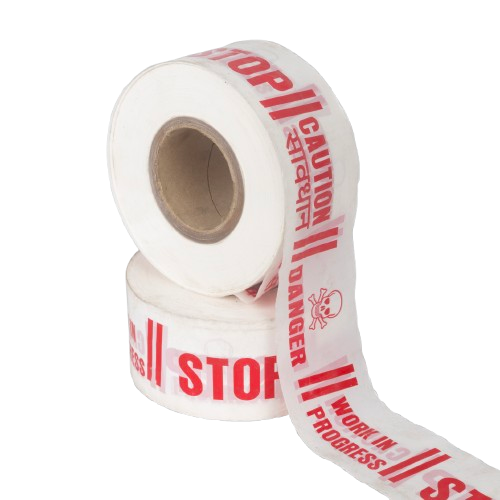
Aspire Enterprises manufactures and supplies caution tape and barricade safety tape for construction sites, highway projects, and industrial facilities across India. It is one of the smallest line items on a material order and one of the easiest to run out of at exactly the wrong moment, right when a trench is open, a machine is running, or a hazard needs to be marked before the next shift arrives on site.
We supply caution tape, safety barricade tape, and warning tape in bulk rolls, built to stay visible and intact through daily site conditions rather than tearing or fading within the first few hours of use.
What Is Caution Tape?
Caution tape is a printed plastic tape, typically bright yellow with bold black text reading “CAUTION,” “DANGER,” or a similar warning, used to mark hazards and restrict access to a work zone. It is a visual signal, not a physical barrier, meant to catch attention from a distance and tell workers and visitors to stay alert or stay out.
On road and infrastructure sites, this shows up constantly around excavation work, such as trenching for a DWC pipe installation, around active machinery zones, and around any temporary hazard that needs to be visible before someone walks into it without warning. If you also need general-purpose packaging tape for site use, our brown and transparent tape range covers that separately from safety marking. For everything else your site needs, our full product range covers the rest of the material list.
Why Site Safety Tape Matters
A construction site changes by the hour. A trench that was fenced off in the morning might be backfilled by afternoon, and a machine zone that was empty at the start of a shift can be active an hour later. Caution tape is the fastest, cheapest way to communicate that change to everyone walking the site without needing a sign, a supervisor standing guard, or a radio call that might not reach everyone in time.
This matters just as much around structural work as it does around excavation. Areas near an expansion joint board installation, or a stretch actively being cut by a groove cutting machine, need clear marking precisely because these zones involve moving equipment and uneven surfaces that are easy to misjudge from a distance.
Types of Caution and Barricade Tape
Standard caution tape: Lightweight and designed for short-term, lower-risk hazards, indoor spaces, minor site work, or areas that only need marking for a few hours or a single shift. It is often used around smaller jobs like crack repair work, where a hazard exists but only for a limited window.
Safety barricade tape: A heavier-duty grade built to survive multiple days of outdoor exposure, wind, and general site wear without tearing. This is the more practical choice for longer-duration hazards, larger perimeters, or zones near active backer cord and debonding strip installation where the work area needs to stay marked for an extended period.
Both types are typically supplied in bright yellow with black warning text, though red and other high-visibility color combinations are also used depending on the specific hazard and site convention.
Caution Tape Specifications
| Specification | Detail |
|---|
| Material | Durable printed plastic film |
| Colour | High-visibility yellow with black text, other colours available |
| Print | Bold, repeated warning text along the full roll length |
| Roll length | Standard bulk roll lengths suited to large-site consumption |
| Grade | Standard caution tape and heavier-duty barricade tape |
| Use | Temporary hazard marking, perimeter warning, restricted access zones |
Choosing between the standard and heavy-duty grade comes down to how long the tape needs to stay up and how exposed it will be to wind, sun, and site traffic during that time.
Where Caution Tape Gets Used on a Road Site
Caution tape shows up around almost every stage of a construction project, from the very first excavation to the final finishing work. Around grade control setups, crews often mark the area near a peg rod and string line to keep foot traffic from disturbing the alignment, and similarly around zones where sensor wire is strung taut at ankle height, a hazard that is easy to miss without a visible marker.
Beyond road work, caution tape is standard practice around any temporary electrical setup, material storage zone, or area undergoing inspection, anywhere a hazard exists that is not obvious just from looking at the site.
How to Choose the Right Caution Tape for Your Site
Start with how long the hazard will stay marked. A short-term indoor issue rarely needs anything beyond standard caution tape, while a multi-day excavation or perimeter around a winch stand and grade control setup calls for the tougher barricade grade that will not tear apart after a day of wind.
Check print visibility next. Tape that fades or becomes hard to read after a day in direct sun defeats its own purpose, especially on a site where a screed vibrator or other heavy equipment is operating nearby, and workers need a clear, unmistakable signal to stay clear.
Why Choose Aspire Enterprises for Caution Tape
Built for real site conditions: Our tape is manufactured to stay legible and intact through a full working day, not just look good on the roll before it goes up.
Full range of grades: From standard caution tape to heavier-duty barricade tape, we supply the right grade for both short-term and extended-duration hazard marking, the same way we match grade to application across our machines range for site equipment.
Bulk supply capability: Large sites go through caution tape faster than most material budgets account for, and we supply it in bulk roll quantities to keep up with continuous consumption across a project, whether that is around excavation, near a needle vibrator compaction zone, or anywhere else a hazard needs marking.
Pan-India delivery: We dispatch to highway contractors, EPC firms, and government construction departments across the country, with the same reliable delivery timelines we maintain across our full material range.
Conclusion
Caution tape rarely gets a mention in a project’s cost report, but running out of it at the wrong moment, right when a trench opens or a hazard appears, is the kind of small gap that leads to preventable accidents. Keep the right grade in stock for the duration each hazard actually needs, and it does its job quietly in the background for the rest of the project. Aspire Enterprises supplies caution tape and barricade safety tape built for real site conditions, with bulk availability and pan-India delivery for highway, industrial, and government projects.



 marketingteam.aspire@gmail.com