Few questions come up as often on Indian road projects as this one. Concrete or bitumen? It is asked by clients weighing budgets, by engineers comparing designs, and by contractors planning their methods. And it rarely has a one-word answer.
Both pavement types build good roads. They simply do it in different ways, with different strengths, different costs, and different maintenance demands over their lives. The right choice depends on traffic, climate, budget, timeline, and how the road will be used.
This article compares concrete and bitumen roads in India honestly. It looks at how each one works, how long each one lasts, what each one costs to build and maintain, and how a contractor or decision maker can think the choice through clearly.
The Basic Difference: Rigid Versus Flexible
The starting point is how each pavement carries a load.
A concrete road is a rigid pavement. The concrete slab is stiff and strong, so it acts like a beam, spreading wheel loads over a wide area and passing only a low pressure down to the layers beneath. The slab itself does most of the structural work.
A bitumen road is a flexible pavement. It is built up in layers of bituminous material and granular courses. It flexes under each wheel load and transmits the load down through the layers, with each layer sharing the work. The strength comes from the whole stack rather than from one slab.
This single difference, rigid slab versus flexible layers, explains almost everything else. It is why concrete lasts longer, why bitumen is faster to build and repair, and why each one behaves the way it does in heat, traffic, and over time.
Which Lasts Longer?
In terms of lifespan, concrete has the clear advantage.
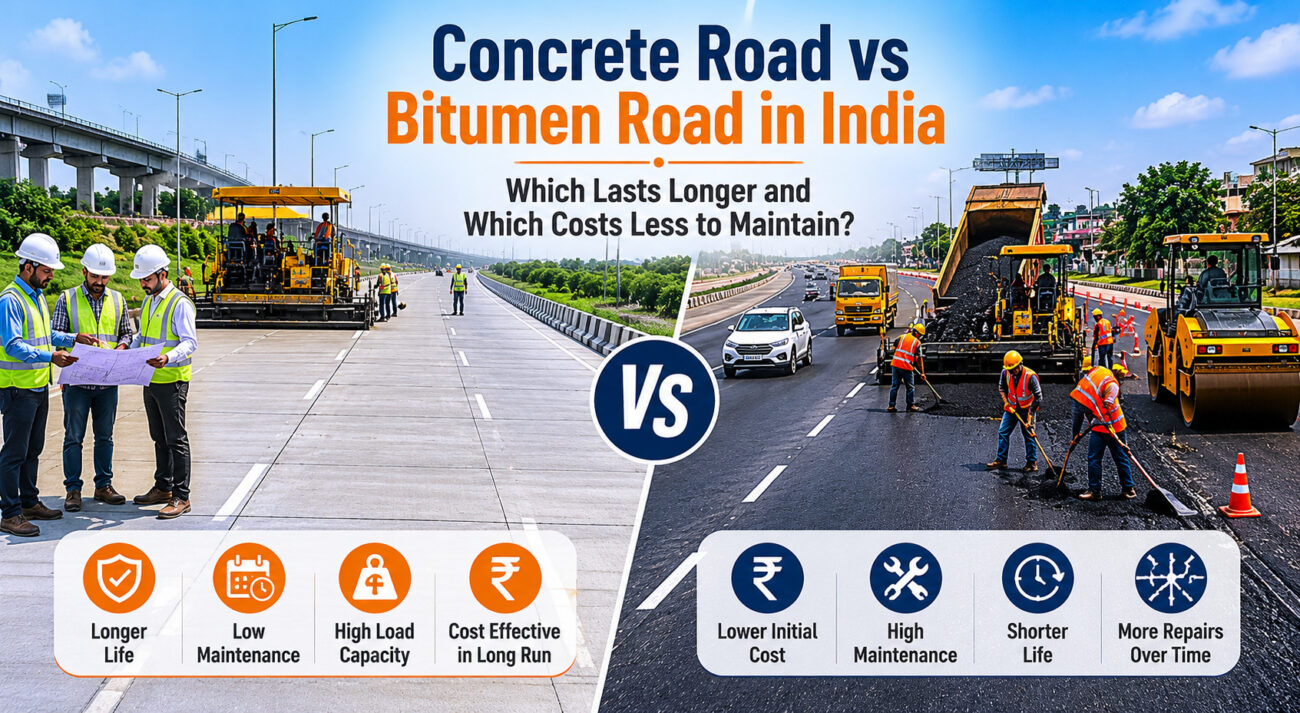
A well-built concrete road is commonly expected to serve for around 25 to 30 years, and in good conditions, concrete pavements can last considerably longer than that. A bitumen road typically has a shorter service life, often in the region of 10 to 15 years before it needs major rehabilitation, and it usually needs periodic resurfacing well before then.
The reason comes back to the materials. Concrete gains strength and is rigid and durable. It is not softened by heat, and it resists rutting from heavy, slow-moving traffic. Bitumen is a viscoelastic material. It can soften in high temperatures, it is prone to rutting under heavy load, and it ages and oxidises over time, which is why cracks and potholes appear and why resurfacing is part of its normal life.
For a road expected to carry heavy traffic for decades, the longer life of concrete is a strong point in its favor.
Which Costs Less?
Cost is where the comparison needs care, because there are two different costs and they point in different directions.
The first is the initial construction cost. Here, bitumen is usually cheaper to build than concrete. Industry comparisons commonly indicate that a concrete pavement costs noticeably more to construct than an equivalent bitumen pavement, with concrete often cited as something in the order of a quarter to a third more expensive at the construction stage.
The second is lifecycle cost, which includes maintenance and rehabilitation over the whole life of the road. Here, concrete tends to come out ahead because it needs less frequent maintenance and lasts longer. Comparisons commonly suggest that the lifecycle cost of a concrete road can work out lower than that of a bitumen road once the years of reduced maintenance are taken into account.
| Factor | Concrete Road | Bitumen Road |
| Pavement type | Rigid | Flexible |
| Typical service life | Around 25 to 30 years or more | Around 10 to 15 years |
| Initial construction cost | Higher | Lower |
| Maintenance frequency | Low | Higher, including periodic resurfacing |
| Lifecycle cost | Often lower over the full life | Often higher over the full life |
| Construction speed | Slower, needs curing time | Faster, quicker to open |
| Performance in heat | Strong, does not soften | Can soften and rut in high heat |
| Ease of repair | Harder, slab based repairs | Easier, patching and overlay |
Actual figures vary widely with location, design, traffic, material rates, and site conditions, so the table shows the general pattern rather than fixed numbers. The honest summary is this: bitumen usually wins on the day you build it, and concrete usually wins when you add up the decades that follow.
Maintenance: A Closer Look
Maintenance is often the deciding factor, so it is worth looking at on its own.
A concrete road is low-maintenance for most of its life. The main maintenance activity is looking after the joints, keeping them sealed so water and debris stay out, and attending to any cracks promptly. Joint sealing materials and crack repair materials are used for this. Done well, this keeps a concrete pavement performing for many years with little disruption to traffic.
A bitumen road is higher maintenance. It needs periodic attention to cracks, rutting, and potholes, and it generally needs resurfacing one or more times within its life. The advantage is that this maintenance is usually quick, and the repairs are simple. A pothole can be patched, and a worn surface can be overlaid without major works.
So the trade-off is real. Concrete requires less overall maintenance, but repairs, when needed, are more involved. Bitumen asks for more frequent maintenance, but each job is faster and easier.
Other Factors Worth Weighing
Lifespan and cost are the headline issues, but a good decision considers a few more.
• Construction speed:
Bitumen is faster to build and can be opened to traffic sooner. Concrete needs curing time before it can take traffic. On projects where speed of opening matters, this counts.
• Heat performance:
In hot regions and with slow, heavy traffic, concrete holds up well because it does not soften. This makes it attractive for industrial roads, ports, and heavy corridors.
• Riding quality:
A good bitumen surface gives a very smooth, quiet ride when new. A concrete surface relies on good construction and texturing to ride well and stay skid-resistant.
• Repairs and utilities:
Bitumen is easier to cut, patch, and reinstate, which matters on roads where utilities are accessed often. Concrete repairs are more involved.
• Drainage and durability:
Concrete stands up well to standing water and waterlogging, which can be useful in areas prone to flooding.
None of these decides the matter alone, but together they shape the right answer for a particular road.
When to Choose Which
There is no universal winner, so the practical guidance is about matching the pavement to the situation.
Concrete tends to be the stronger choice for heavily trafficked corridors, roads carrying slow heavy commercial vehicles, industrial and port roads, locations with high temperatures, and areas prone to waterlogging. It suits situations where a long life and low maintenance over decades are the priority.
Bitumen tends to be the stronger choice where the initial budget is tight, where the road needs to be built and opened quickly, where traffic is lighter, and where easy future repairs and utility access matter. It suits situations where flexibility and speed are valued.
Many road networks use both, choosing the pavement type corridor by corridor. The decision is an engineering and economic judgment, and it should be made on the specific traffic, climate, budget, and timeline of each road.
Common Misconceptions to Avoid
• “Concrete is always more expensive.” It usually costs more to build, but over the full life, its lower maintenance can make it competitive or cheaper.
• “Bitumen is always cheaper.” It is cheaper to build, but frequent maintenance and resurfacing add up over the years.
• “One type is simply better.” Each suits different conditions. The right choice depends on the road.
• “Concrete needs no maintenance.” It is low maintenance, not no maintenance. Joints and cracks still need care.
• “Bitumen cannot handle heavy traffic.” It can, when properly designed, but it may need more maintenance under heavy, slow loads.
• “The cheapest option saves money.” The cheapest to build is not always the cheapest to own.
Best Practices for the Decision and the Build
• Compare lifecycle cost, not just construction cost, when choosing a pavement type.
• Match the choice to the actual traffic, climate, budget, and required opening time.
• For concrete pavements, build the joints and the crack control system well, since they determine durability.
• For concrete, keep joints sealed and attend to cracks promptly to protect the long life.
• For bitumen, plan and budget for periodic maintenance and resurfacing from the start.
• Whichever type is chosen, build it to the relevant standards and specifications, because workmanship decides real-world performance.
Conclusion
Concrete road versus bitumen road is not a contest with a single winner. It is a choice between two good pavement types that succeed in different ways. Concrete lasts longer and asks for less maintenance over the decades, but it costs more to build and takes longer to open. Bitumen is cheaper and faster to build and easy to repair, but it needs more frequent maintenance and has a shorter life.
The sound way to decide is to compare the full lifecycle, not just the construction bill, and to match the pavement to the traffic, the climate, the budget, and the timeline of the specific road. And whichever type is chosen, the real performance comes from building it properly. A concrete road only delivers its long life if its joints and crack control are built with care, and a bitumen road only delivers its value if its maintenance is planned and funded. Choose well, build well, and either pavement will serve.
Frequently Asked Questions
Which lasts longer, a concrete road or a bitumen road?
A concrete road generally lasts longer. A well built concrete pavement commonly serves for around 25 to 30 years or more, while a bitumen road typically has a service life in the region of 10 to 15 years before major rehabilitation.
Which is cheaper, a concrete road or a bitumen road?
A bitumen road is usually cheaper to build, while a concrete road often has a lower lifecycle cost because it needs less maintenance and lasts longer. The cheapest to construct is not always the cheapest to own.
Why does a concrete road need less maintenance?
A concrete road is a rigid pavement that is durable, does not soften in heat, and resists rutting. Its main maintenance is keeping the joints sealed and attending to cracks, which is far less frequent than the resurfacing of a bitumen road needs.
What is the difference between rigid and flexible pavement?
A rigid pavement is a concrete road where a stiff slab spreads the load over a wide area. A flexible pavement is a bitumen road, built in layers that flex under load and share the load down through the structure.
Which road performs better in hot weather?
Concrete performs better in hot weather because it does not soften. Bitumen is viscoelastic and can soften and rut at high temperatures, especially under slow, heavy traffic.
Which road is faster to build?
A bitumen road is faster to build and can be opened to traffic sooner. A concrete road needs curing time before it can carry traffic, so it generally takes longer to complete.
Which road is easier to repair?
A bitumen road is easier to repair, since it can be patched and overlaid quickly. Concrete repairs are more involved because they often deal with slabs and joints.
When should concrete be chosen over bitumen?
Concrete is generally preferred for heavily trafficked corridors, slow heavy commercial traffic, industrial and port roads, hot regions, and waterlogging-prone areas, where a long life and low maintenance are the priority.