
Introduction
A concrete pavement is not one continuous slab. It is a series of slabs separated by joints, and traffic has to cross those joints thousands of times a day without feeling a single bump. The component that makes this possible is the dowel bar.
Dowel bars are simple looking pieces of steel, yet they carry one of the most demanding jobs in a rigid pavement. Get the assembly right and the joints stay quiet and level for decades. Get it wrong and the pavement starts faulting, cracking, and spalling within the first few seasons.
This guide walks through dowel bar assembly the way a site team actually deals with it. It covers what the parts do, what sleeves and caps are for, the sizes and spacings to expect, and the installation steps that decide whether a joint performs or fails.
What Is a Dowel Bar Assembly?
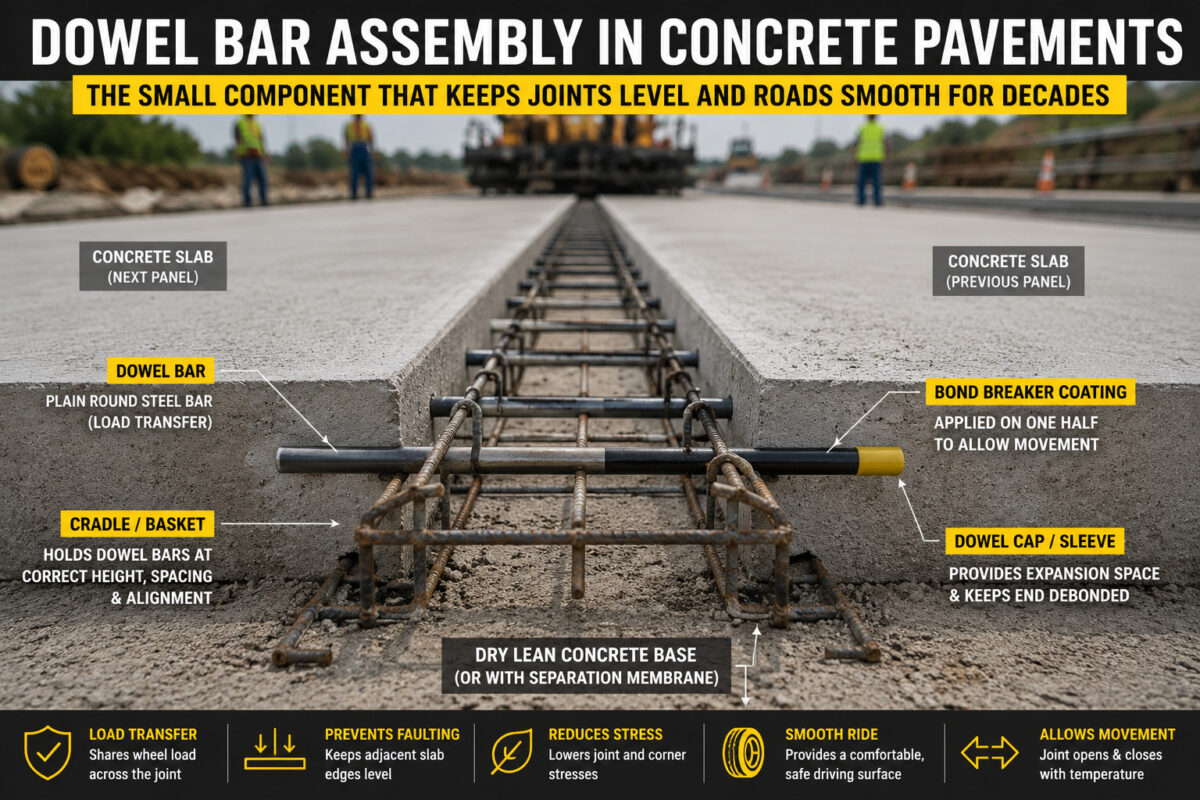
A dowel bar assembly is the complete arrangement of plain round steel bars, their coatings, end caps or sleeves, and the support cradle that holds them in position across a transverse joint in a concrete pavement.
The dowel bar itself is a smooth mild steel round bar placed at mid depth of the slab, running in the direction of traffic and crossing the joint so that half of it sits in one slab and half in the next. Around the bar sits everything that makes it work correctly: a bond breaking coating so it can slide, a cap or sleeve at one end on expansion joints, and a cradle or basket that fixes the bars at the right height, spacing, and alignment before concreting.
When people on site say “dowel assembly”, they mean this whole package, not just the bar.
Why Dowel Bars Matter
The purpose of a dowel bar is load transfer. When a wheel approaches a joint, the slab it is sitting on starts to deflect. The dowel bar carries part of that load across to the next slab, so both slabs deflect together instead of one dropping while the other stays put.
That single function delivers several outcomes:
•It prevents faulting:
Faulting is the stepping you feel when one slab edge sits lower than the next. Good dowels keep adjacent slab edges level.
•It reduces joint stress:
Sharing the load means neither slab edge is overloaded, which protects the concrete from corner cracking.
•It keeps the ride smooth:
Level joints mean vehicles cross without the repeated impact that damages both the road and the traffic on it.
•It still allows movement:
Because the bar is smooth and coated on one side, the joint can open and close with temperature while the bar continues to transfer load.
That last point is the clever part. A dowel bar has to be rigid enough to carry load yet free enough to let the slab move. The whole assembly is designed around that balance.
Dowel Bars vs Tie Bars
These two are constantly confused on site, so it is worth being clear.
| Feature | Dowel Bar | Tie Bar |
| Bar type | Plain round, smooth | Deformed, ribbed |
| Location | Transverse joints | Longitudinal joints |
| Main job | Transfer load, allow joint movement | Hold slabs together, resist separation |
| Movement | Slab can slide along the bar | No movement, fully bonded |
| Coating | One half debonded with bond breaker | Fully bonded, no debonding |
In short, a dowel bar lets slabs move while still sharing load. A tie bar stops slabs from drifting apart and is meant to stay locked. Using one in place of the other defeats the design, so the assembly drawings should always be checked before fabrication.
Components of a Dowel Bar Assembly
The dowel bar:
A plain round mild steel bar, smooth so the slab can slide along it. It is placed at mid depth of the slab and parallel to both the pavement surface and the centre line.
Bond breaker coating:
One half of every dowel is coated with a debonding compound such as a thin bituminous or plastic coat. This stops the concrete from gripping that half, so the joint can open and close freely. Without it, the bar locks the joint.
Dowel cap or sleeve:
At expansion joints, a cap fits over the coated end of the bar. It has a small void at its closed end, usually around 20 mm, that gives the bar room to push into the cap as the slab expands. A close fitting dowel bar sleeve over the bar also helps keep that end debonded and protected. At plain contraction joints a cap may not be needed, but the bond breaker coating still is.
Cradle or dowel basket:
This is the wire support frame that holds all the dowels of a joint at the correct height, spacing, and angle. It is anchored to the dry lean concrete base so the bars do not shift when concrete is placed around them.
Each part has a single job, and the assembly only works when all of them are correct together.
Dowel Bar Size and Spacing
Dowel dimensions depend on slab thickness and the design traffic, so the project drawings and pavement design always govern. The values below are the common reference points contractors see on PQC highway work.
| Parameter | Common Value | Notes |
| Diameter | 32 mm to 38 mm | Increases with slab thickness; thicker slabs use larger bars |
| Length | About 500 mm | Half in each slab across the joint |
| Spacing | 250 mm to 300 mm centre to centre | As per pavement design |
| Position | Mid depth of slab | Parallel to surface and centre line |
| Material | Plain round mild steel | Smooth, not deformed |
As a general rule, dowel bars are not provided for slabs thinner than about 200 mm, because thin slabs do not have the depth for an effective bar. For PQC slabs of 250 mm and above, a dowelled joint is standard. Always confirm the exact diameter, length, and spacing from the approved pavement design rather than assuming a single set of figures, since these vary with traffic category and slab thickness.
Sleeves and Caps Explained
Site teams sometimes treat the cap as a small extra. It is not. On an expansion joint, the cap is what allows the joint to actually expand.
Picture a hot afternoon. The slabs grow. If the dowel bar had nowhere to go, it would push hard against the concrete at its end and crack it. The dowel cap solves this. The void inside the cap gives the bar a pocket to slide into as the slab expands. The compressible filler in the expansion joint board takes up the rest of the movement at the joint face.
The sleeve, meanwhile, is about debonding and protection. A sleeve that fits closely over the coated half of the dowel keeps that half free to slide and shields the coating during concreting. When you order a dowel bar sleeve, check that it suits the bar diameter and that the cap end has the correct void depth for the expansion gap in the design.
This is where the dowel assembly connects to the rest of the joint system. The cap, the sleeve, the bond breaker, and the expansion joint board all work together. A good expansion joint board takes the compression at the joint face while the cap takes the bar movement behind it.
Step by Step: Installing a Dowel Bar Assembly
1. Read the joint layout:
Confirm joint type, dowel diameter, length, and spacing against the approved drawings before anything is fabricated.
2. Prepare and accept the base
The dry lean concrete sub base must be accepted and clean. Where a separation membrane is used under the PQC slab, plan how the cradle anchoring works with it.
3. Fabricate the cradle accurately:
Build or check the dowel basket so every bar sits at mid slab depth, at the right spacing, and truly parallel. The cradle controls alignment, so it must be rigid.
4. Coat and cap the bars:
Apply the bond breaker to one half of each bar. Fit dowel caps or sleeves on the coated end at expansion joints, keeping the expansion void clear.
5. Set and anchor the assembly:
Place the cradle across the joint line and fix it firmly to the base so concreting cannot push it out of position.
6. Check alignment before concreting:
Verify that bars are horizontal, parallel to the centre line, and at mid depth. This check is the most important step in the whole process.
7. Concrete carefully around the assembly:
Place and vibrate concrete so the bars are fully surrounded but not displaced. Keep the needle vibrator clear of the bars themselves.
8. Match the joint to the assembly:
When the contraction joint is later saw cut, it must line up directly above the dowels. A joint cut off line from the dowels will not behave correctly.
If a dowel bar inserter is used behind a slipform paver, the cradle step is replaced by the machine, but the same alignment discipline applies. The inserter must place bars straight, level, and on line.
Alignment: The Detail That Decides Everything
If there is one thing to take away from this guide, it is that dowel alignment matters more than almost anything else in the assembly.
A dowel bar is meant to slide. It can only slide if it is straight and parallel to the direction the slab moves. When bars are skewed sideways or tilted up or down, the joint can no longer open and close freely. The bars lock the slabs. Locked slabs build up stress, and that stress comes out as cracking near the joint and spalling at the joint edges.
Misalignment usually creeps in from a weak cradle, careless concreting, or an inserter that is not set correctly. The fix is simple in principle: build a rigid assembly, anchor it well, check it just before the pour, and place concrete without knocking the bars. A few minutes of checking prevents a defect that is expensive and disruptive to repair later.
Common Mistakes to Avoid
• Skipping the bond breaker coating. An uncoated dowel bonds on both sides and locks the joint.
• Skewed or tilted bars. Misaligned dowels are the leading cause of joint distress.
• A flimsy cradle. A weak basket lets the bars move when concrete is placed.
• Wrong diameter or spacing. Using a single assumed size instead of the pavement design value.
• Forgetting caps on expansion joints. Without the void, the bar has nowhere to move and cracks the slab.
• Crushing the cap void. If the expansion void is blocked or filled, the cap cannot do its job.
• Joint cut off line. A saw cut that does not sit above the dowels undermines load transfer.
• Heavy vibration on the bars. Running the vibrator against the bars displaces them.
Best Practices for Dowel Bar Assembly
• Always work from the approved pavement design for diameter, length, and spacing.
• Use straight, clean, plain round mild steel bars with no rust scale or bends.
• Coat exactly one-half of each bar and keep the coating even.
• Build cradles rigidly and anchor them so they cannot shift during concreting.
• Fit dowel caps or sleeves correctly and keep the expansion void open.
• Inspect alignment as a formal hold point just before each pour.
• Position the saw cut for the contraction joint directly above the dowel line.
• Keep the assembly square to the joint and parallel to the centre line at all times.
Conclusion
Dowel bars look like the simplest steel on a concrete road, yet they decide how every joint performs for the life of the pavement. The bar carries the load, the bond breaker lets the joint move, the cap gives expansion room, and the cradle holds it all true. None of it works alone.
The recurring theme is alignment. A rigid cradle, correct coating, properly fitted caps, and a careful pour give you joints that stay level and quiet for decades. Rushed, skewed, or under specified assemblies give you faulting and cracking that are costly to fix. Treat the dowel assembly as a precision item, check it as a hold point before every pour, and the joints will reward that discipline.
Frequently Asked Questions
What is a dowel bar assembly in rigid pavement?
A dowel bar assembly is the complete arrangement of smooth steel dowel bars, bond breaker coating, end caps or sleeves, and a support cradle placed across a transverse joint. It transfers wheel load between slabs while still allowing the joint to open and close.
What is the purpose of a dowel bar?
A dowel bar transfers load from one concrete slab to the next across a transverse joint. This keeps adjacent slab edges level, prevents faulting, reduces joint stress, and keeps the ride smooth while still allowing the joint to move.
What is the difference between a dowel bar and a tie bar?
A dowel bar is smooth, sits at transverse joints, transfers load, and allows the joint to move. A tie bar is deformed, sits at longitudinal joints, and holds slabs together without allowing movement.
What is a dowel bar cap or sleeve used for?
A dowel cap fits over one end of the bar at expansion joints and provides a small void so the bar can slide into it as the slab expands. A sleeve keeps the coated end debonded and protected. Together they let the joint expand without cracking the concrete.
What size and spacing are dowel bars?
Dowel bars are commonly 32 mm to 38 mm in diameter, about 500 mm long, and spaced 250 mm to 300 mm centre to centre. Exact values come from the approved pavement design and depend on slab thickness and traffic.
Why is dowel bar alignment important?
A dowel bar can only allow joint movement if it is straight and parallel to slab movement. Skewed or tilted bars lock the joint, which causes cracking and spalling. Alignment is the single most important installation check.
Are dowel bars needed for every concrete slab?
No. Dowel bars are generally not provided for slabs thinner than about 200 mm. For PQC highway slabs of 250 mm and above, dowelled transverse joints are standard practice.
Why is one half of a dowel bar coated?
One half is coated with a bond breaker so the concrete cannot grip it. This lets the slab slide along the bar as the joint opens and closes, while the bonded half still anchors the bar for load transfer.
Related Blogs
PQC Road Construction Step by Step: Materials, Equipment, and Accessories Required
How to Cut Contraction Joints in PQC Roads: Timing, Depth, and Blade Selection Guide
String Line Setup for Concrete Paver: How Peg Rods and Sensor Wire Work Together for Perfect Grade Control