Introduction
Concrete shrinks as it cures. That is not a defect; it is physics, and there is nothing a contractor can do to stop it. What a contractor can do is decide where the resulting cracks appear. That decision is made with a saw, and it is made within a window of just a few hours.
Contraction joint cutting is one of the most time-critical operations in PQC road construction. Cut at the right moment, to the right depth, in the right place, and the slab cracks neatly under the joint where it is meant to. Miss the window, cut too shallow, or cut offline, and the slab cracks where it wants to, randomly and visibly.
This guide explains how to cut contraction joints in PQC roads. It covers why the joints exist, the timing window, the correct depth, joint spacing, and how to select the right blade for the job.
What Are Contraction Joints and Why Cut Them?
A contraction joint is a deliberate, controlled line of weakness cut into a concrete slab so that the inevitable shrinkage crack forms there and nowhere else.
When a fresh slab cures and cools, it shrinks. A long slab cannot shrink freely without building tensile stress, and concrete is weak in tension. At some point, that stress exceeds the strength of the concrete, and it cracks. The only question is where.
By saw cutting a groove into the slab, the contractor reduces the section at that line. The slab is now weakest exactly along the cut, so the crack forms there, directly under the groove. The crack runs down from the bottom of the saw cut in a straight, controlled line. The joint is later cleaned and sealed so the crack stays protected.
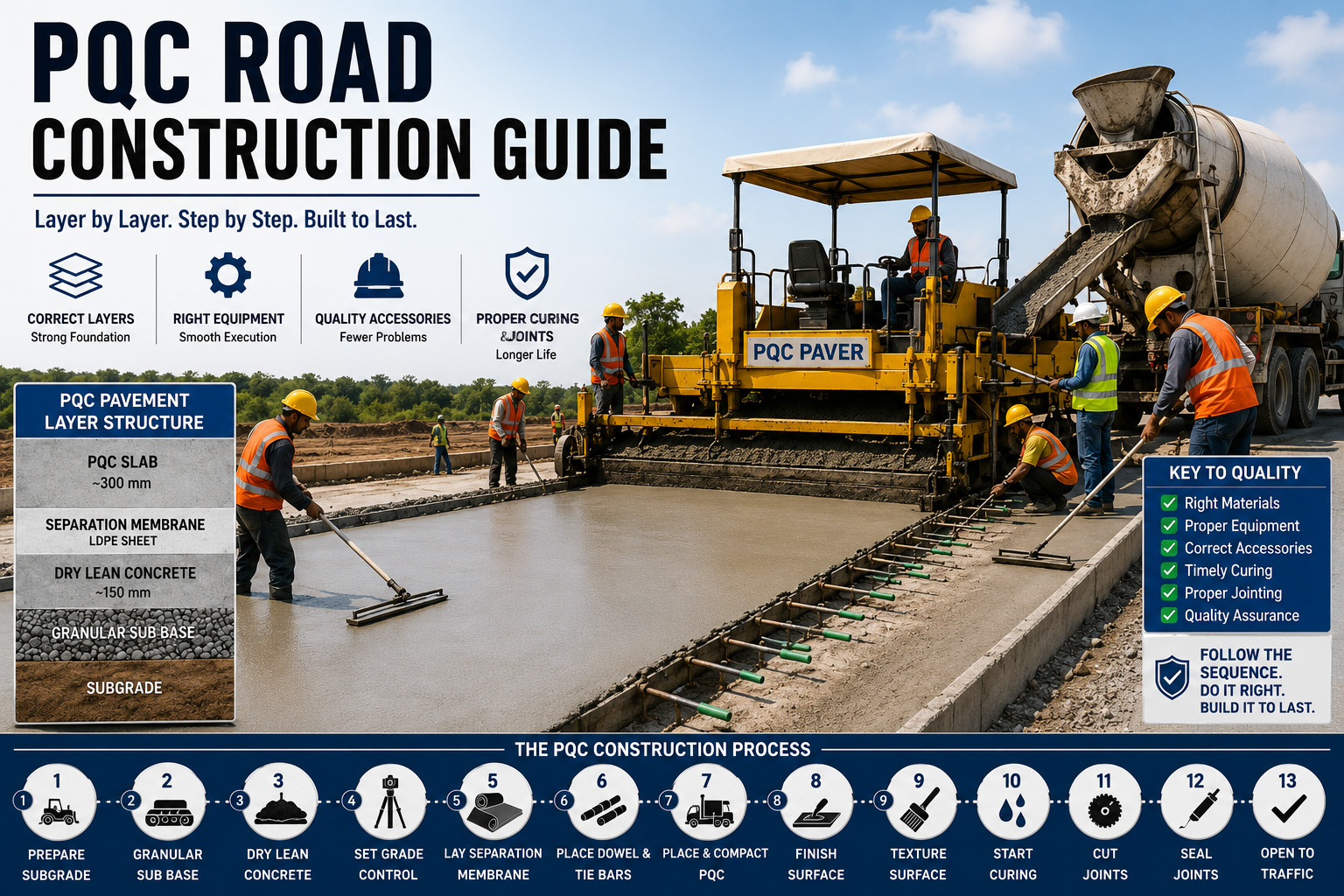
This is why contraction joints are part of the crack control system, working together with the separation membrane that lets the slab move and the dowel bars that carry load across transverse joints. Cut the joints correctly, and the system works. Skip or delay them, and it does not.
The Sawing Window: Timing Is Everything
The single hardest part of joint cutting is timing, because the right moment is a window, not a fixed time.
Cut too early, and the concrete is still soft. The saw tears and raves the edges of the groove instead of cutting a clean line, and the aggregate can be pulled out. Cut too late, and the slab has already built up enough shrinkage stress to crack on its own, randomly, before the saw ever reaches it.
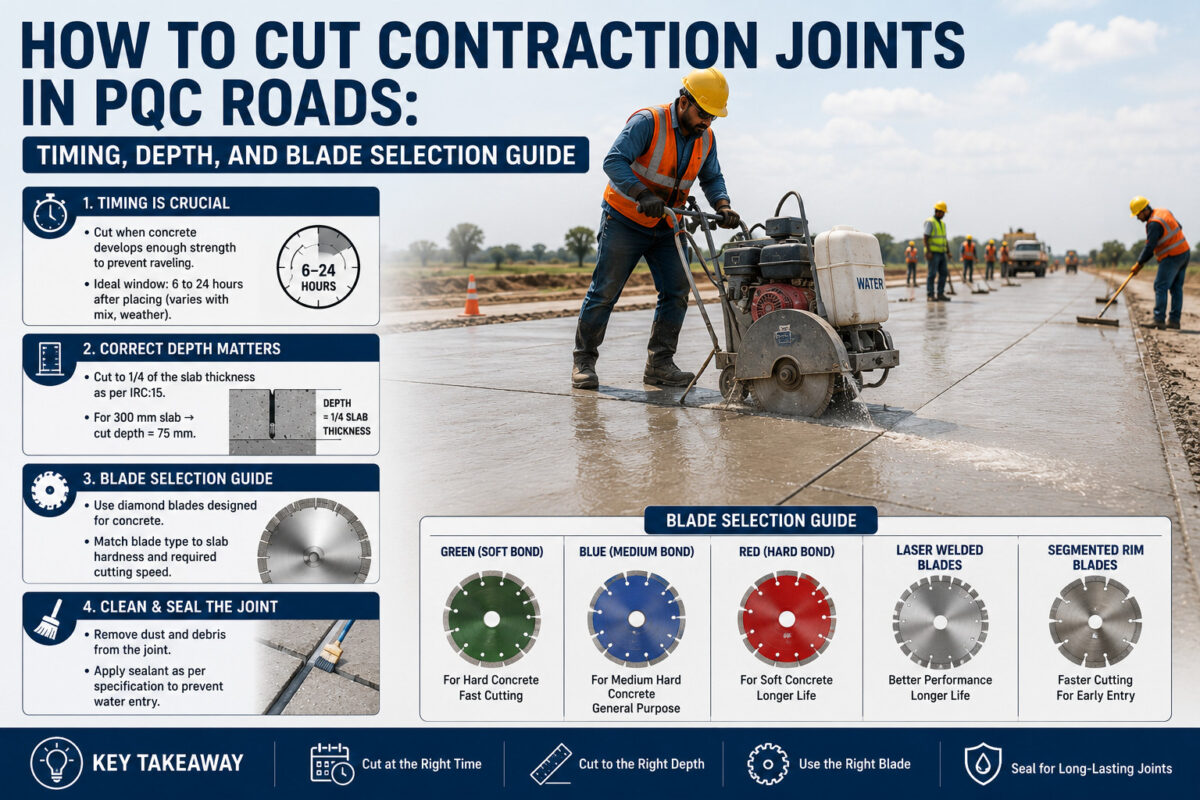
The correct window opens when the concrete is hard enough to saw cleanly without raveling, and it closes before shrinkage stress causes uncontrolled cracking. As a general guide, transverse contraction joints are often cut within around 24 hours of paving, but the exact window depends heavily on the concrete mix, the cement, the slab thickness, the weather, and the ambient temperature.
This is why crews test the window rather than assume it. They make a trial cut and watch the edge. If the cut ravels and pulls aggregate, it is too early. If the edge cuts clean, the window is open. On hot, dry, or windy days, the window opens sooner and closes faster, so the team has to be ready and watching. Joint cutting is planned as a continuous operation that follows the paving, not as a job left for the next shift.
How Deep Should a Contraction Joint Be Cut?
Depth decides whether the crack actually follows the joint.
The saw cut has to be deep enough to create a genuine weak plane through the slab. As a widely used rule, contraction joints are cut to between one quarter and one third of the slab depth, and in no case less than one-quarter. For a typical PQC slab, that means a substantial groove, not a token scratch.
If the cut is too shallow, the weak plane is not weak enough. The slab still has plenty of strength below the groove, the shrinkage crack does not follow the cut, and it breaks out somewhere else instead. A shallow cut is one of the most common reasons contraction joints fail to control cracking.
The depth comes from the project specification and the slab thickness, so it should be set out and checked, not estimated. The saw must be set and confirmed to cut to the specified depth on every joint.
| Parameter | General Guidance | Notes |
| Cut depth | One quarter to one third of slab depth | Never less than one quarter |
| Timing | Often within about 24 hours of paving | Window varies with mix and weather |
| Spacing | Commonly around 4.5 m for highway slabs | Always set by the pavement design |
| Cut width | Narrow initial groove | Widened later if needed for sealing |
Contraction Joint Spacing
Joint spacing determines how long each slab panel is. If panels are too long, the slab can crack in the middle before it reaches a joint. If they are reasonable, each panel shrinks and moves within safe limits.
Spacing depends on slab thickness and the pavement design. For highway PQC slabs, transverse contraction joint spacing is commonly in the region of 4.5 m, but this is always governed by the design, which considers slab thickness and other factors. The contractor’s job is to set the joints out exactly as designed and to make sure each saw cut lands on its planned line, directly above any dowel bars at that joint.
A joint cut off its planned line, or out of line with the dowels beneath it, will not perform as intended, so accurate setting out is as important as accurate cutting.
Selecting the Right Blade
The blade is where joint cutting succeeds or fails on cost and quality. The wrong blade cuts slowly, wears fast, and gives a poor groove.
Joint cutting in concrete uses diamond blades. The important points when selecting one are:
• Match the bond to the aggregate:
Diamond blades have a metal bond that holds the diamonds. As a general principle, hard aggregate calls for a softer bond so fresh diamonds keep exposing, and softer aggregate calls for a harder bond so the blade lasts. Using a mismatched blade wastes the blade and slows the cut.
• Choose the correct diameter:
The blade must be large enough to reach the specified cut depth with the particular machine.
• Match wet or dry cutting to the blade:
Conventional wet cutting blades are run with water for cooling. Early entry dry cutting systems use blades made for that method. The blade and the cutting method have to suit each other.
• Use a quality blade:
A cheap blade that wears quickly or cuts unevenly costs more in lost time and poor joints than it saves in price.
The groove cutting machine and the blade are a pair. A well-maintained machine with the correct blade for the aggregate and the depth gives clean, fast, consistent joints. Keeping a stock of the right blades on site avoids the worst situation in joint cutting, which is waiting for a blade while the sawing window closes.
Step by Step: Cutting Contraction Joints
1. Set out the joints. Mark every joint line from the pavement design, ensuring transverse joints sit directly above the dowel bars.
2. Prepare the machine and blade. Fit the correct diamond blade for the aggregate and depth, check the machine, and arrange water for wet cutting.
3. Watch for the window. Monitor the concrete as it hardens, particularly in hot or windy conditions when the window opens early.
4. Make a trial cut. Cut a short test length and inspect the edge. If it unravels, wait. If it is clean, begin.
5. Set the depth. Set the saw to cut to the specified depth, between one-quarter and one-third of the slab thickness.
6. Cut on the line. Guide the saw accurately along each marked joint line, keeping the cut straight.
7. Work in sequence. Cut joints in the planned order so the slab is relieved before stress builds, prioritizing as the design and conditions require.
8. Clean the groove. Flush and clean the saw slurry and debris from the joint.
9. Prepare for sealing. Once joints are cut and ready, place backer rod where required, prime the joint faces, and apply the joint sealant.
10. Inspect. Check each joint for correct depth, straightness, and clean edges, and treat any random cracks with appropriate crack repair materials.
Common Mistakes to Avoid
• Cutting too early: Raveling, torn edges, and pulled aggregate spoil the groove.
• Cutting too late: The slab cracks on its own before the saw arrives.
• Cutting too shallow: The weak plane is not deep enough to control the crack.
• Joints offline: A cut that misses its planned line or the dowels below will not perform.
• Wrong blade for the aggregate: Slow cutting, fast wear, and poor grooves.
• Ignoring the weather: Hot, dry, windy conditions shorten the window dramatically.
• No trial cut: Guessing the window instead of testing it.
• Leaving slurry in the joint: A dirty groove cannot be sealed properly.
• No spare blades: A blade failure mid-run can cost the whole sawing window.
Best Practices for Joint Cutting
• Set out every joint accurately from the design, aligned with the dowels.
• Plan joint cutting as a continuous operation that follows paving closely.
• Watch the concrete and the weather, and make a trial cut to confirm the window.
• Cut to the specified depth, between one-quarter and one-third of the slab.
• Select the diamond blade to match the aggregate, the depth, and the cutting method.
• Keep the groove cutting machine maintained and keep spare blades on site.
• Clean joints thoroughly before sealing, and seal with the specified materials.
• Inspect joints after cutting and address any random cracking promptly.
Conclusion
Cutting contraction joints is a small operation with an outsized effect. A few straight grooves, cut at the right moment and to the right depth, decide whether a concrete pavement cracks neatly under its joints or randomly across its surface for everyone to see.
The three things to get right are timing, depth, and the blade. Watch the concrete and the weather and cut within the window. Cut to between one quarter and one third of the slab depth, nevertheless. Match the diamond blade to the aggregate and keep spares ready. Set the joints out accurately, clean them, and seal them. Treated with that discipline, joint cutting turns the unavoidable shrinkage of concrete into a controlled, predictable result, and that is exactly what a long-lasting PQC road needs.
Frequently Asked Questions
What is a contraction joint in a PQC road?
A contraction joint is a saw-cut groove deliberately made in a concrete slab to create a weak plane. The shrinkage crack then forms under the joint in a controlled location instead of appearing randomly across the slab.
When should contraction joints be cut?
Contraction joints should be cut once the concrete is hard enough to saw cleanly without raveling but before shrinkage stress causes uncontrolled cracking. This window is often within about 24 hours of paving, but it varies with the mix and the weather.
How deep should a contraction joint be cut?
A contraction joint is generally cut to between one-quarter and one-third of the slab depth and never less than one-quarter. The exact depth is taken from the project specification and the slab thickness.
What happens if a contraction joint is cut too late?
If the joint is cut too late, the slab builds up enough shrinkage stress to crack on its own before the saw reaches it. The crack then appears randomly instead of following the planned joint line.
What happens if the cut is too shallow?
A cut that is too shallow does not create a weak enough plane. The slab keeps too much strength below the groove, so the shrinkage crack does not follow the joint and breaks out elsewhere.
How far apart are contraction joints spaced?
Contraction joint spacing depends on slab thickness and the pavement design. For highway PQC slabs, it is commonly in the region of 4.5 m, but the design always governs the exact spacing.
Which blade is used to cut contraction joints?
Contraction joints in concrete are cut with diamond blades. The blade bond should match the hardness of the aggregate, and the blade diameter must be large enough to reach the specified cut depth.
How should joints be treated after cutting?
After cutting, the joint groove is cleaned of slurry and debris, backer rod is placed where required, the faces are primed, and the joint is sealed with the specified sealant to keep the crack protected.
Related Blogs
Dowel Bar Assembly in Rigid Pavement: Sleeves, Caps, and Correct Installation

Separation Membrane in PQC Roads: Why LDPE Is the Standard Choice

IRC:15 Standards for Concrete Road Construction: What Contractors Must Comply With in 2026