Introduction
Ask three suppliers for a quote on plastic sheeting for a concrete road and you will often get three different products described with the same word. One calls it polythene. One calls it LDPE. One just calls it a plastic sheet. The prices vary, and the buyer is left guessing whether they are comparing like with like.
They usually are not. The confusion between LDPE sheets and polythene sheet is one of the most common procurement traps on road projects, and it has real consequences when the sheet in question is the separation membrane under a PQC slab.
This buyer’s guide settles the question. It explains what polythene and LDPE actually mean, whether they are the same or different, why the difference matters for road work, and how to specify and buy the correct sheet with confidence.
Clearing Up the Confusion First
Here is the short answer, and then the rest of the article explains it.
Polythene and LDPE are not opposites, and they are not exactly the same either. Polythene is a broad family of plastics. LDPE is one specific member of that family. So every LDPE sheet is a polythene sheet, but not every polythene sheet is LDPE.
Think of it like the word “vehicle.” A truck is a vehicle, but if you order “a vehicle” you might get a scooter. When a supplier says “polythene sheet”, they have told you the family, not the exact product. When they say “LDPE sheet”, they have told you the specific type. For a road project, that precision is the whole point.
What Is Polythene?
Polythene, more properly polyethylene, is one of the most widely used plastics in the world. It is the material behind carry bags, packaging film, water tanks, pipes, and construction sheeting. The word “polythene” on its own simply says the sheet is made of polyethylene. It does not say which grade, what density, what thickness, or whether the raw material is virgin or recycled.
Because the term is so broad, a “polythene sheet” in the market can be almost anything. It could be a thin, flimsy film or a tough heavy-gauge sheet. It could be made from fresh polymer or from reprocessed scrap. Two sheets, both honestly described as polythene, can perform completely differently.
What Is LDPE?
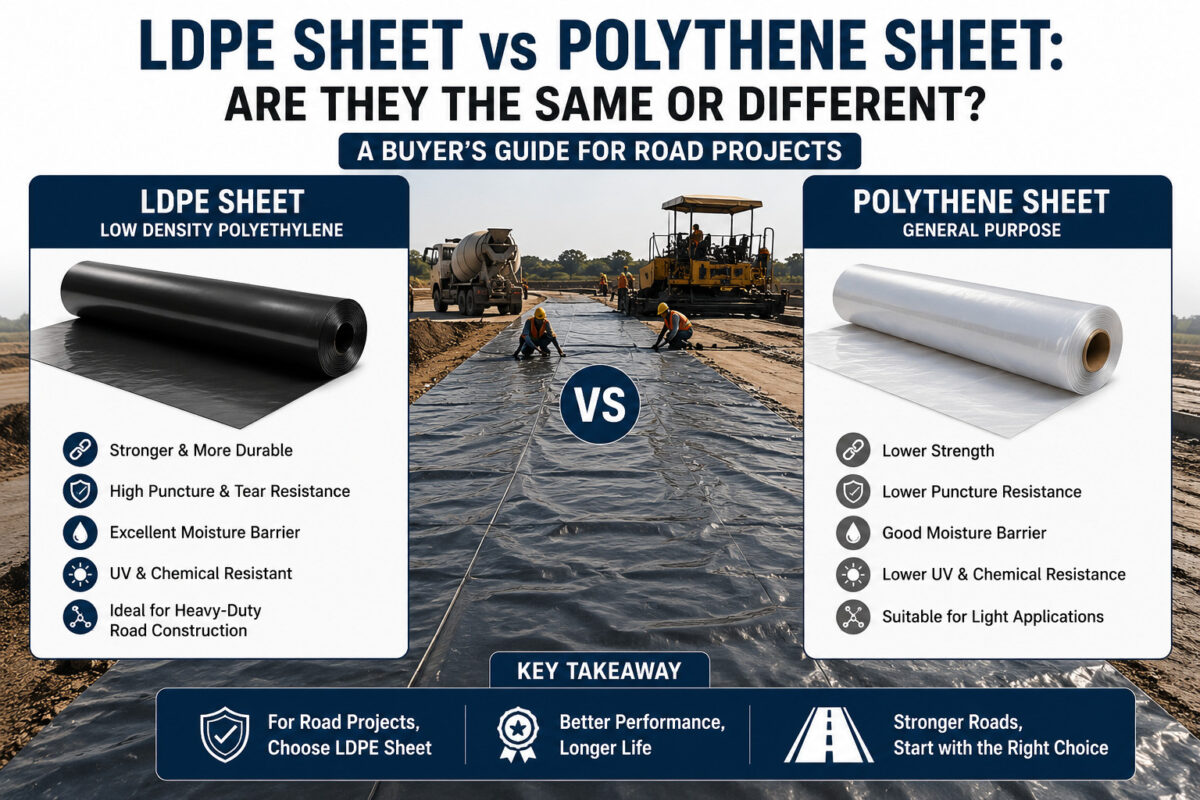
LDPE stands for low-density polyethene. It is a specific type of polyethene with a particular molecular structure that makes it soft, flexible, and tough. LDPE film drapes well, resists tearing, stretches a little before it fails, and is genuinely impermeable to water when made from good material.
Those properties are exactly what a separation membrane needs. When a specification calls for an LDPE sheet, it is naming a material whose behaviour is known and predictable. That is why road and bridge specifications for the separation membrane refer to low-density polyethene rather than just “polythene.”
LDPE, HDPE and LLDPE
The polyethylene family has several members, and it helps a buyer to know the main ones.
| Type | Character | Typical Use |
| LLDPE, linear low-density | Soft, flexible, tough, drapes well | Separation membranes, films, liners |
| HDPE, high-density | Strong, very good puncture and tear resistance | Stretch films, heavy duty liners |
| Stretch films, heavy-duty liners | Stiff, hard, rigid | Pipes, tanks, geomembranes |
For a PQC separation membrane, LDPE is the type that is normally specified because it conforms well to the base, lies flat, and survives handling on site. HDPE is stiffer and suits different applications. The point for a buyer is simple: “polythene” does not tell you which of these you are getting, but “LDPE” does.
Are They the Same or Different? The Honest Answer
So, are LDPE sheet and polythene sheet the same or different?
They are related, but they are not interchangeable as purchasing terms. LDPE is a precise specification. Polythene is a loose, general description. If you order a “polythene sheet” you have left the grade, density, raw material quality, and thickness open to interpretation, and you may receive something far below what a road project needs. If you order an “LDPE sheet” to a stated thickness and quality, you have specified the product.
For everyday uses such as covering materials from rain, the loose term is harmless. For the separation membrane in a concrete pavement, it is not. The membrane has a structural role in how the slab moves and cracks, so it must be the right material, and that means specifying LDPE properly rather than accepting a generic polythene sheet.
Why the Difference Matters for Road Projects
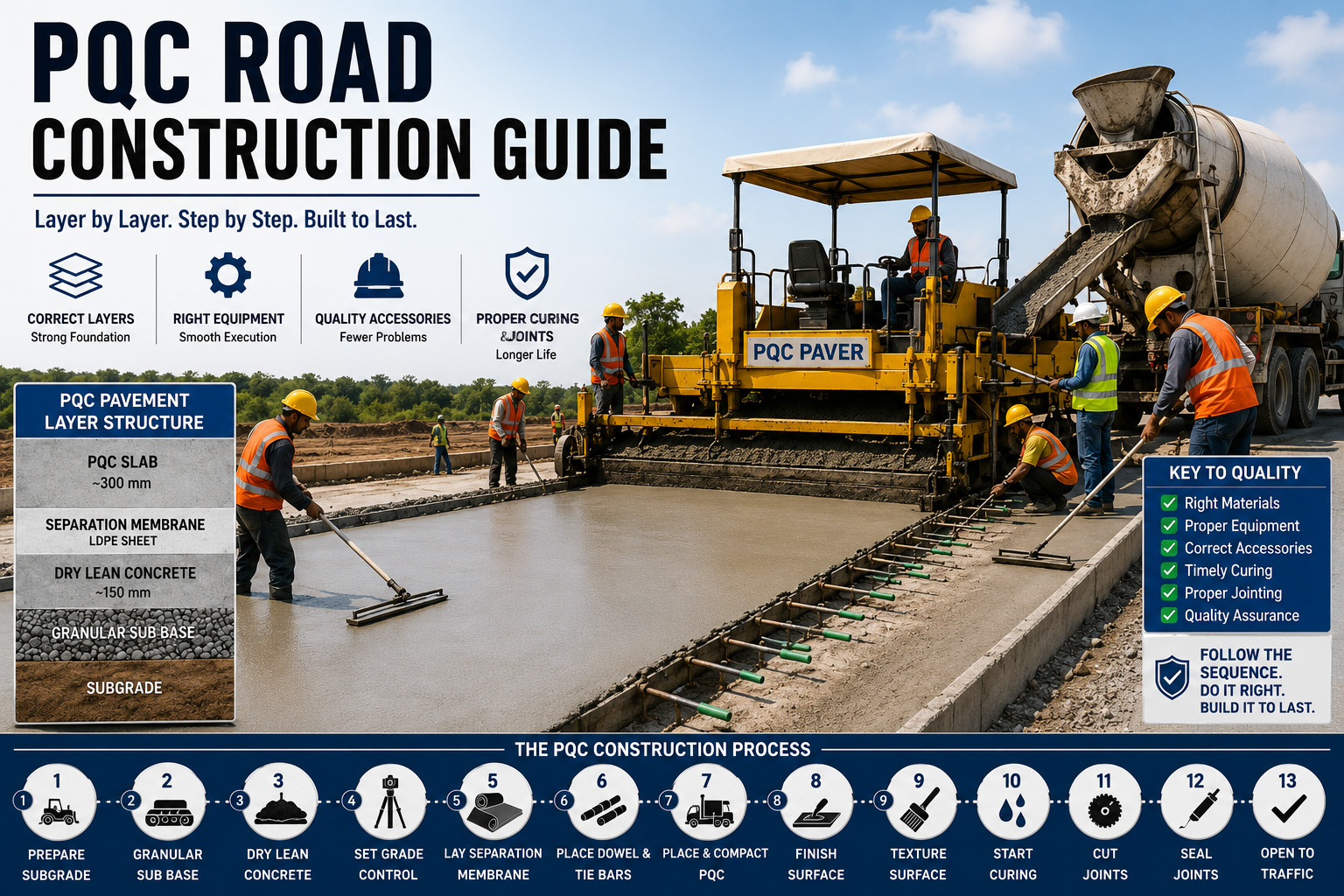
On a PQC road, the plastic sheet under the slab is the separation membrane. Its job is to let the concrete slab slide and move freely over the dry lean concrete base, and to stop fresh concrete from losing water into that base. It is part of the crack control system of the pavement.
If a cheap, thin, or recycled polythene sheet is substituted for proper LDPE, several things can go wrong. The sheet may tear under boots and the weight of fresh concrete, breaking the continuous separation layer. It may not be fully impermeable, letting the base drink the mix water. It may be the wrong thickness and simply not perform. None of these failures are visible once the concrete is poured, but they can show up later as cracking and surface problems.
That is why the separation membrane is always treated as a specified item. The right product is virgin LDPE at the correct thickness, and that is also why this topic connects directly to wider PQC accessory selection, where the cheapest option and the correct option are often not the same thing.
Virgin vs Recycled
One more distinction matters as much as LDPE versus polythene, and that is virgin versus recycled material.
Virgin LDPE is made from fresh polymer. It has consistent thickness, predictable strength, and reliable impermeability. Recycled polythene is made from reprocessed scrap. It is cheaper, but it can be inconsistent in thickness, weaker, more prone to tearing, and may contain fillers or carbon black that affect its behaviour.
For a separation membrane, road and bridge specifications generally call for virgin LDPE and specifically exclude recycled material, fillers, and carbon black based sheeting. A transparent or white sheet is often required partly because colour helps confirm it is virgin material rather than dark recycled stock. When buying, virgin grade is not an upgrade. It is the specification.
How to Buy the Right Sheet for a Road Project
Use this checklist when sourcing a separation membrane so that “polythene” never becomes a guessing game.
1. Specify LDPE by name: Ask for a low-density polyethene sheet, not just polythene.
2. State virgin grade: Require virgin LDPE and exclude recycled material, fillers, and carbon black.
3. State the thickness: Give the required thickness in microns, taken from the project specification, and do not leave it open.
4. State the width: Order wide rolls so there are fewer joints in the laid membrane.
5. State the color: Transparent or white is commonly required and helps confirm virgin material.
6. Ask for documentation: Request a test certificate or technical data sheet and keep it for the engineer.
7. Compare like with like: When comparing quotes, make sure every supplier is pricing the same LDPE specification, not a cheaper generic sheet.
8. Check on delivery: Verify the delivered rolls match the specification before they reach the paving crew.
Common Buying Mistakes to Avoid
• Ordering “polythene” with no grade: This leaves the supplier free to send the cheapest option.
• Comparing price without comparing specifications: A lower quote for a generic sheet is not a saving.
• Accepting recycled material: Recycled polyethene may fail the specification and tear on-site.
• Leaving thickness unstated: A thin sheet will not survive the pour, whatever it is called.
• Ignoring documentation: With no test certificate, quality cannot be demonstrated.
• Treating the membrane as a minor buy: It is a specified, structural part of the pavement.
• Mixing up LDPE and HDPE: They behave differently, so the specified type must be supplied.
Best Practices for Specifying Sheeting
• Always write the requirement as a virgin LDPE sheet with a stated thickness, width, and colour.
• Take the thickness from the project specification rather than from a supplier suggestion.
• Insist on documentation and keep it on file for inspections.
• Buy from a supplier who understands road project requirements and supplies to specification.
• Inspect every delivery and reject anything that does not match.
• Educate the procurement team that polythene is a family and LDPE is the product.
Conclusion
LDPE sheets and polythene sheets are not rivals. They are a specific product and a general family. The trouble starts when the general word is used in place of the specific one during purchasing, because that is when a road project ends up with a sheet that was never fit for the job.
For a separation membrane under a PQC slab, the answer is clear. Specify virgin LDPE by name, state the thickness, width, and colour, ask for documentation, and make sure every quote is pricing the same thing. The membrane is a small line item with a structural role, so treat it as a specified material, not as generic plastic. Get the words right at the purchase order stage and the right product follows.
Frequently Asked Questions
Is an LDPE sheet the same as a polythene sheet?
Not exactly. Polythene, or polyethene, is a broad family of plastics, and LDPE is one specific type within it. Every LDPE sheet is a polythene sheet, but a polythene sheet is not necessarily LDPE. LDPE is a precise specification, while polythene is a general term.
What does LDPE stand for?
LDPE stands for low-density polyethene. It is a soft, flexible, tough form of polyethene that drapes well, resists tearing, and is impermeable to water when made from good-quality material.
Which sheet is used as a separation membrane in PQC roads?
A virgin LDPE sheet of the specified thickness is used as the separation membrane in PQC roads. It is laid between the dry lean concrete base and the PQC slab to allow the slab to move and to prevent water loss into the base.
Why is LDPE preferred over generic polythene for road work?
LDPE is a known, consistent specification with the flexibility, toughness, and impermeability needed for a separation membrane. Generic polythene can be any grade or quality, including thin or recycled material that may fail on site.
What is the difference between virgin and recycled polythene?
Virgin polythene is made from fresh polymer and has consistent thickness and strength. Recycled polythene is made from reprocessed scrap and can be inconsistent, weaker, and may contain fillers. Separation membranes generally require virgin material.
Can HDPE be used instead of LDPE for a separation membrane?
HDPE is stiffer and harder than LDPE and is used for different applications, such as pipes and geomembranes. For a separation membrane, the specification normally calls for LDPE because it conforms to the base and lies flat.
What thickness of LDPE sheet should I buy?
The thickness should be taken from the project specification and stated in microns when ordering. A common requirement for separation membranes is in the range of around 125 microns, but the contract documents always govern.
How can I tell if a sheet is genuine virgin LDPE?
Genuine virgin LDPE is usually transparent or white, has consistent thickness, and comes with a test certificate or technical data sheet. Dark, inconsistent, or undocumented sheeting suggests recycled material.
Related Blogs
Separation Membrane in PQC Roads: Why LDPE Is the Standard Choice
How Properly Storing Road Construction Materials Improves Project Quality
PQC Road Construction Step by Step: Materials, Equipment, and Accessories Required