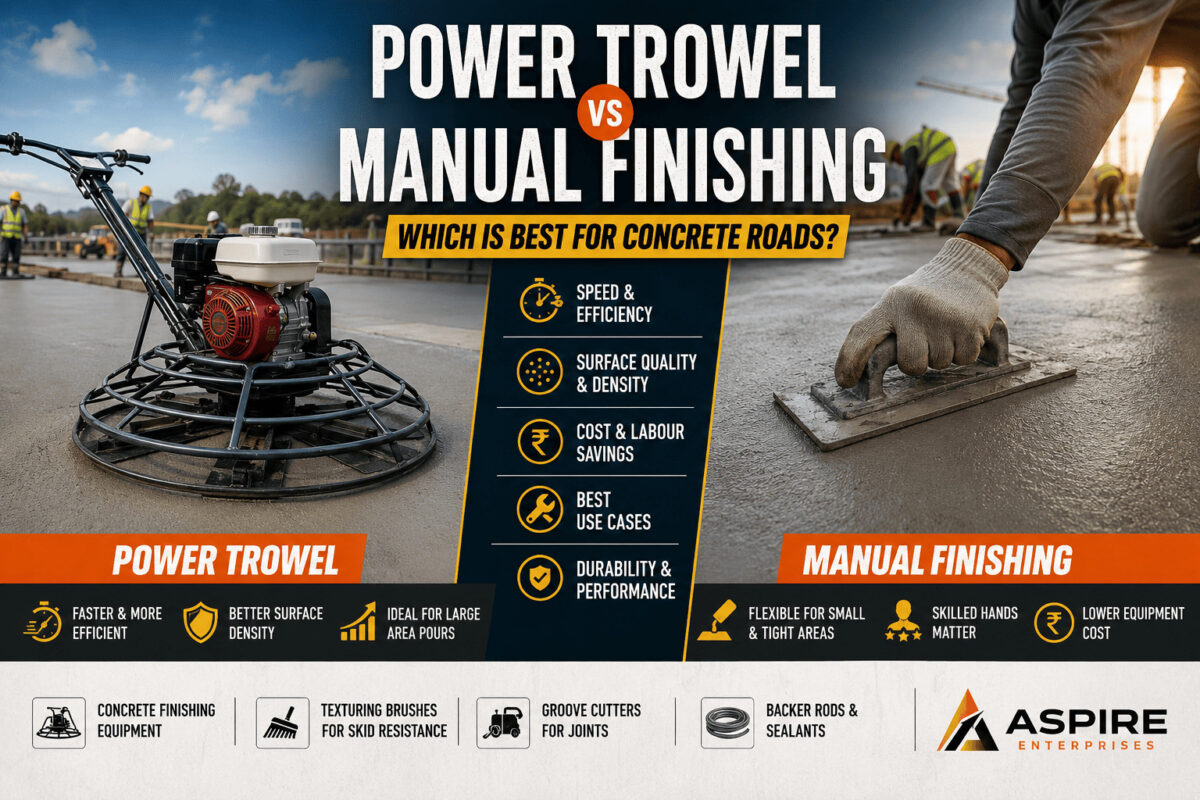
Power Trowel vs Manual Finishing: Which Is Better for Concrete Roads?
Why Concrete Finishing Matters
Nobody talks about concrete finishing until something goes wrong with it. Then it’s all anyone talks about. A surface that’s been finished poorly, whether too early, too late, or just inconsistently, shows up fast under traffic. Surface scaling, dusting, premature wear, loss of skid resistance. These problems almost never come from a bad concrete mix. They come from finishing decisions made on site, often under time pressure, often without the right equipment. On any serious PQC highway or urban CC road project, there’s really only one finishing method worth discussing: a power trowel machine. It’s faster, more consistent, and produces a denser, harder surface than manual methods can deliver on large pours. The question isn’t really whether to use one. It’s when, at what blade angle, and in how many passes. This guide breaks down the comparison honestly so you know exactly what you’re choosing between.
One thing both manual and mechanical finishing have in common: neither is the last step. After you’ve trowelled the surface to the required smoothness, you still need to apply a surface texture before the concrete sets. On a concrete road, a smooth trowelled surface is actually a dangerous surface when wet. The texturing brush drawn transversely across the fresh concrete creates the groove pattern that channels water away from the tyre contact patch and gives you the skid resistance value IRC 15 requires. Miss that step or rush it and you’ve built a road that becomes a skid hazard in the first monsoon. So when you’re comparing finishing methods, factor in the full sequence: screed, float, trowel, texture. Aspire Enterprises supplies the power trowel machines, texturing brushes, and all the finishing accessories you need for CC and PQC road projects.
What Is Manual Concrete Finishing?
Manual finishing is exactly what it sounds like: workers using hand tools to level, float, and trowel the concrete surface after it’s been struck off by the screed. It’s the older method, it’s still in use, and for small pours in awkward locations it genuinely makes sense. On a 50-square-metre rural CC road patch or a narrow footpath, setting up a power trowel creates more problems than it solves. But walk onto a national highway paving project and suggest doing the finishing by hand and you’ll get some very odd looks. The scale, the timing demands, and the surface quality requirements simply don’t allow it.
Tools Used in Manual Finishing
The sequence goes: screed board to strike off excess and get initial level, then bull float to embed coarse aggregate and flatten ridges, then darby float for smaller areas, then steel finishing trowels for the final surface closure. On larger operations, a screed machine handles the first pass so workers aren’t trying to manually drag a straight edge across a 7.5-metre lane. Even on manual finishing sites, mechanising the screeding step makes a real difference to the flatness you can achieve before the float work begins.
Advantages of Manual Finishing
• Works anywhere — no machine access needed, no fuel, no operator training requirement
• Good for edge zones, corners, and areas around fixed joint formwork where machines can’t reach
• Skilled finishers can address specific surface defects that a rotating machine would miss
• Lower equipment cost for genuinely small pours where a machine would sit idle most of the day
Disadvantages of Manual Finishing
• On anything larger than a few hundred square metres, finishing speed becomes a serious problem
• Surface quality varies pour to pour depending on who’s working and how tired they are
• Slower pace means the concrete can stiffen before finishing is complete, especially in hot weather
• You simply cannot achieve the surface density by hand that a power trowel machine delivers
What Is Power Trowel Finishing?
A power trowel is a petrol or electric machine with rotating blades that float and finish a concrete surface by applying consistent downward pressure as it moves across the slab. The operator controls blade pitch and travel speed. Early passes with flat pans close the surface and embed aggregate. Later passes with angled finish blades compress the surface layer, increase density, and produce the smooth, hard finish the IRC requires before texturing. For PQC national highways, CC urban roads, and industrial floors, it’s the standard finishing method and has been for years. Concrete compaction before trowelling matters just as much. A needle vibrator run properly around dowel bar assemblies and near formwork edges is what gives you a fully consolidated slab going into the finishing stage. Voids in the concrete at that point don’t get fixed by trowelling over them.
Types of Power Trowels
Walk-behind trowels are what you’ll see on most Indian CC road sites. One operator, 600 to 900 mm width per pass, suitable for two-lane road sections and areas where the larger machines can’t manoeuvre. Ride-on trowels are for large pours: the operator sits on the machine, covers 2,400 mm or more per pass, and finishes five to eight times the area per hour that a walk-behind manages. If your project involves long highway paving runs, a ride-on is not a luxury.
Advantages of Power Trowel
• Area coverage is not comparable. A ride-on trowel finishes what a manual crew would take all day to complete in a couple of hours
• Surface density and hardness are measurably better than manually finished concrete
• Consistent blade pressure across the full pass means consistent surface quality, no patches of soft or rough finish
• Closes surface capillary pores, which reduces permeability and improves long-term durability
• Reduces the number of workers needed on the slab at the critical finishing stage
Disadvantages of Power Trowel
• Higher upfront cost, though it recovers quickly on any project over a few thousand square metres
• Operator skill matters. Wrong blade angle at the wrong time gives you a delaminated surface
• Tight corners, edges, and areas within 300 mm of formwork still need manual touch-up after the machine
• Over-trowelling on concrete that’s too stiff creates a burnt, weakened surface layer
Head-to-Head Comparison
Let’s put the two side by side on the factors that actually matter to a road contractor or project engineer, not just surface smoothness in a lab.
Speed and Efficiency
A ride-on power trowel covers 500 to 800 square metres an hour. A solid manual finishing team on a good day manages 50 to 80. On a standard 7.5-metre two-lane highway section, power trowelling is six to ten times faster. That’s not a marginal difference. It’s the difference between finishing a day’s pour before the concrete sets and scrambling to finish in fading light with concrete that’s getting harder by the minute.
Surface Quality and Density
Mechanically applied pressure from a power trowel compresses the surface mortar layer in a way no bull float or steel trowel can replicate over a large area. The result is a harder surface, lower permeability, and better abrasion resistance. On a road that’ll take years of tyre scuff from heavy vehicles, that surface density pays for itself in reduced wear and fewer maintenance interventions early in the road’s life.
Cost Analysis
The machine costs more upfront. That’s true. But on any pour above 500 square metres, the labour saving more than covers the equipment cost and you finish faster with a better surface. Factor in that a power trowel-finished surface with correct joint management, including expansion joint board at the right intervals and polysulphide sealant after curing, significantly extends the road’s service life. The savings on early maintenance alone justify the equipment investment within the first few years of operation.
Best Use Cases
• Power trowel: PQC national highways, CC urban roads, expressways, airport aprons, any pour above 300 square metres
• Manual finishing: Footpaths, small rural CC patches, repair sections, edges and corners after machine passes
• Combined: Ride-on or walk-behind trowel for open slab area, manual steel trowel at edges and around joint formwork
• Either way: Texturing brush pass is non-negotiable for IRC-compliant skid resistance on any concrete road surface
The Verdict
For PQC highways, CC urban roads, and any large concrete pour, use a power trowel. That’s not a debatable point on projects of that scale. Manual finishing has a place on small rural roads, repair patches, and access-restricted sections, and a good finisher can produce decent results in those situations. But it can’t replace a machine on a highway pour. What does apply to both methods equally: once the trowel work is done, joint cutting with a groove cutting machine needs to happen within the correct window after pour, typically 6 to 18 hours depending on weather and mix. Then after curing, backer cord goes in before the polysulphide sealant. Miss the joint cutting window and you get random cracking. Skip the backer cord and your sealant debonds. These steps aren’t optional finishes. They’re what keeps the road performing for its full design life.
• Power trowel for every high-volume large-area pour. No argument.
• Manual only where machines genuinely can’t operate or the pour is very small
• Texturing brush after trowelling, no matter which method you used to get there
• Joint cutting window: 6 to 18 hours after pour. Don’t miss it.
• Backer cord first, then polysulphide sealant, after design strength is reached
Want to know more about what we do and what we supply? Check our About Us page.
FAQs: Power Trowel vs Manual Finishing
1. Can a power trowel be used on all concrete mixes?
Mostly yes, but the concrete needs the right workability and the timing needs to match the set rate of that specific mix.
2. How long after pouring concrete can you use a power trowel?
When you can walk on it without sinking more than a few millimetres. Usually 1 to 3 hours, but mix and weather change that.
3. Does power troweling increase concrete strength?
Not bulk strength, no. But it densifies the surface layer significantly, which improves hardness and abrasion resistance.
4. Is manual finishing still used on large road projects?
Not as the primary method. Edges and corners get manual touch-up, but the main slab area needs a machine.
5. What blade type is best for power troweling road concrete?
Float pans first to close the surface, then finish blades for the final density pass. Blade angle increases with each pass.