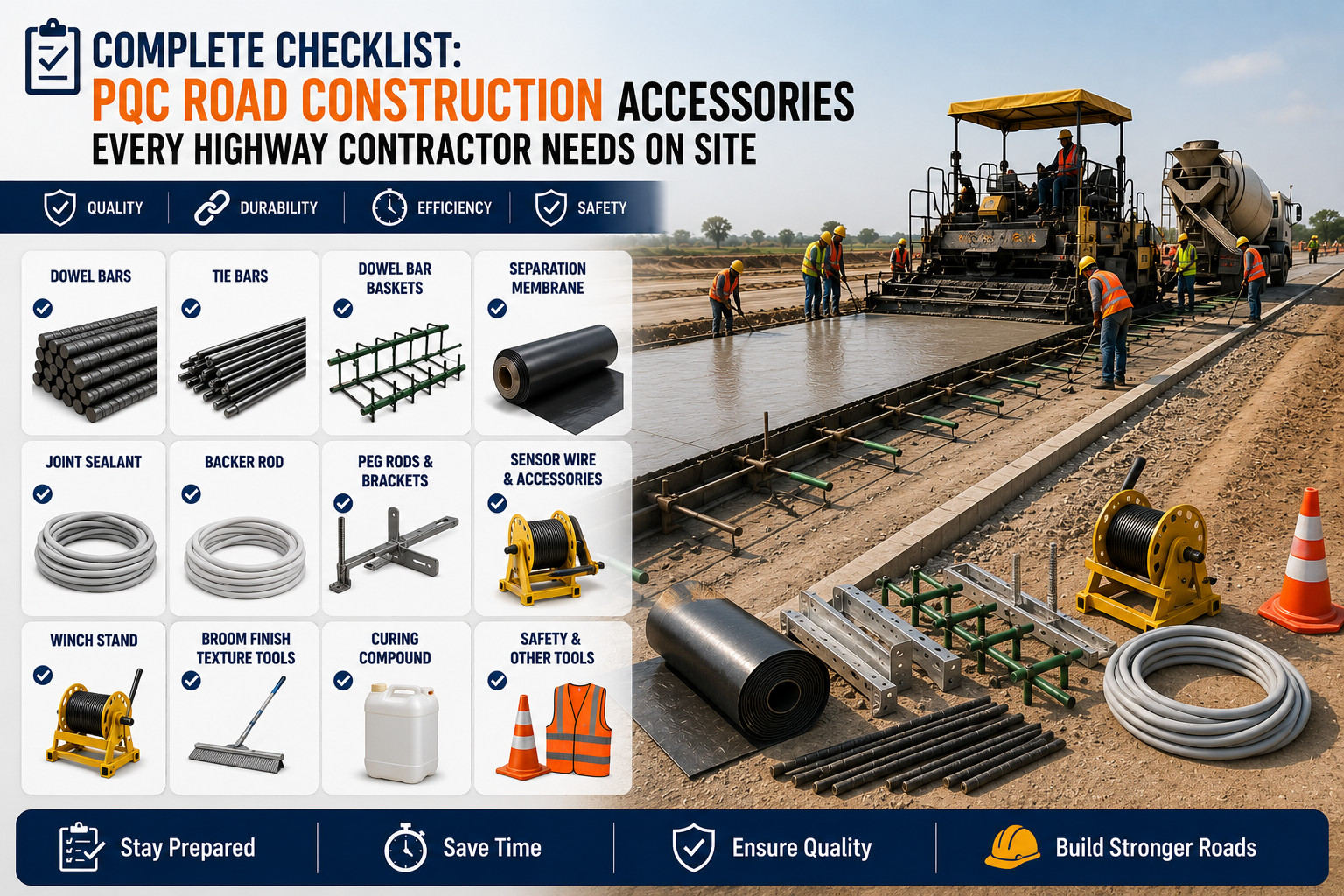

Every experienced site engineer has a story about a project that ran short of a critical accessory mid-pour. It is rarely the concrete itself that runs out. It is the dowel bar sleeves, or the separation membrane, ordered based on a rough estimate that did not quite match what the paving program actually needed.
Material estimation on a road project sounds like a simple exercise: multiply length by width by thickness and order accordingly, but the reality involves a long list of secondary materials that are easy to underestimate precisely because they are not the headline item on the bill of quantities.
This guide walks through how to estimate materials for a concrete road project properly, covering the core concrete quantities as well as the joint and accessory materials that are easy to underestimate.
How do you estimate materials for a concrete road project?
Estimating materials starts with the approved drawings. Calculate concrete volume from length, width, and thickness per section, then calculate accessory quantities like dowel bar sleeves, backer cord, and sealant from joint spacing and total joint length, adding a realistic wastage margin for each material.
Why Accurate Material Estimation Matters
An estimate that runs short stalls the pour and forces an urgent reorder, often at a worse price and with a delivery delay the schedule cannot absorb. On a fast-moving paving program, a stalled pour does not just lose the time for that section; it can push back every subsequent section that depended on the site being clear for the next stage of work.
An estimate that runs too high ties up budget in excess material sitting in storage, and for materials with a limited shelf life, such as sealants, that excess can end up wasted entirely rather than simply sitting unused. Getting the estimate right the first time avoids both problems and keeps the project’s cash flow and storage space working efficiently.
Estimation accuracy also affects supplier relationships over the life of a project. A contractor who consistently orders close to what they actually use builds credibility with suppliers, which can translate into better pricing, priority during periods of high demand, and more flexibility on payment terms. A contractor whose orders are wildly inconsistent, alternating between shortages and excess, is harder for a supplier to plan around and less likely to receive that kind of flexibility.
Key Inputs Needed Before Estimating Materials
Before any quantity can be calculated, a few inputs need to be confirmed from the project design, the pavement length and width, the slab thickness, the joint spacing and type as set by the pavement design, and the specification for each accessory, since quantities depend directly on the sizes and grades called for in the drawings rather than on assumed standard values.
It is worth confirming these inputs directly against the latest approved drawings rather than an earlier draft, since design revisions partway through a project are common, and an estimate built on outdated joint spacing or slab thickness will be wrong in a way that only becomes obvious once the shortfall hits site.
It also helps to note down any project-specific tolerances or approved substitutions at this stage, since some projects allow a documented deviation from a standard specification for a particular material, and building the estimate around the actual approved specification rather than a generic assumption avoids both underordering and overordering relative to what will genuinely be used on site.
Estimating Core Concrete Materials
Steel reinforcement, where the design calls for it, follows a similar logic to accessory estimation rather than the simpler volume-based approach used for concrete. Reinforcement quantities depend on bar spacing, diameter, and lap lengths set by the structural design and should be estimated directly from the reinforcement drawings rather than approximated as a percentage of concrete volume, since that shortcut tends to be inaccurate for anything beyond a rough preliminary budget figure.
Cement, Aggregate and Sand Quantities
Cement, aggregate, and sand quantities follow directly from the approved mix design once the total concrete volume is known. Using the actual mix design proportions rather than a generic rule of thumb matters here since PQC mixes are designed to a specific flexural strength and the material ratios vary accordingly from one project to another depending on the aggregate source and the strength requirement.
Concrete Volume Calculation Method
Concrete volume for a road slab is calculated as length multiplied by width multiplied by thickness, applied to each paving section in the program. For a straightforward rectangular slab this is simple, but where the design includes tapers, superelevation, or varying thickness sections, the estimate needs to be broken down section by section rather than averaged across the whole length, since averaging tends to under-order the thicker sections and leaves the crew short exactly where the extra volume was needed most.
Wastage Allowance and Safety Margins
A wastage allowance accounts for spillage, minor over-excavation, and material lost to testing and quality checks. Typical allowances vary by material and site conditions, so referring to the project specification or standard practice for the specific material is more reliable than applying a single blanket percentage to everything, since a margin appropriate for bulk aggregate is not necessarily appropriate for a lower-volume, higher-cost item like sealant.
Estimating Joint and Accessory Materials
It is worth noting that accessory specifications sometimes vary along the length of a single project, for instance, where expansion joints are used at bridge approaches or structure interfaces but not along the general running length. Estimating accessory quantities section by section, matching the actual joint design at each location, avoids the common error of applying one joint type’s accessory ratio uniformly across a project that actually uses more than one joint design.
This is the category where estimates most commonly fall short, since accessory quantities depend on joint counts and lengths rather than the more intuitive slab area calculation used for concrete.
Cross-checking accessory estimates against the concrete estimate for internal consistency is also a useful final step, since the number of joints implied by the concrete section lengths and the specified joint spacing should match the joint count used to calculate dowel, sleeve, and sealant quantities, and any mismatch usually points to an error worth catching before the order is placed rather than after.
Dowel Bars and Dowel Bar Sleeves
Dowel bar quantities follow from the joint spacing and the number of bars per joint as set by the pavement design, typically spaced 250 to 300 millimeters apart across the lane width. One sleeve is required per dowel at expansion joints, so the sleeve count should match the dowel count for those joint types, not the total dowel count across the whole project, since contraction joints typically do not use sleeves in the same way.
Expansion Joint Boards and Backer Cords
Expansion joint board quantity is based on the total length of expansion joints multiplied by the slab depth the board needs to cover. Backer cord length runs along the full length of every contraction and expansion joint that will be sealed, so this quantity should be calculated against total joint length across the project, not just the expansion joints, which is a distinction that catches out estimates built around the expansion joint board quantity alone.
Polysulphide Sealant Quantity
Sealant quantity depends on the joint width, depth, and total joint length, since sealant fills the joint reservoir above the backer rod. A rough volume calculation based on joint cross section and total length gives a reasonable estimate, but it is worth adding a margin for joints that end up slightly wider than specified after saw cutting, since actual cut width often varies a little from the design value.
LDPE Separation Membrane Area
Membrane area is based on the total slab area to be covered, plus an allowance for overlaps at every sheet joint, typically a minimum of 300 millimetres per lap. On a long paving run with a standard roll width, this overlap allowance adds up across many laps and should not be left out of the estimate, since ignoring it can leave the project short by a meaningful percentage of total membrane area on a long corridor.
Common Estimation Mistakes to Avoid
A few recurring mistakes cause more shortfalls than any others. Estimating membrane or accessory quantities from total slab length without accounting for overlaps or per-joint quantities is one of the most common. Using a generic wastage percentage instead of checking what is realistic for the specific material is another.
Estimating joint accessories separately from the concrete estimate rather than as part of the same planning exercise often means they get looked at later and rushed, with less time available to catch errors before ordering. Not revisiting the estimate when the paving program changes partway through the project is another recurring cause, since a design change to joint spacing or slab thickness invalidates the original accessory quantities without necessarily triggering a formal re-estimate unless someone actively remembers to do one.
Another frequent mistake is failing to communicate estimate assumptions clearly between the person who prepared the estimate and the person placing the actual purchase order, which can result in an order based on outdated figures or a misunderstood specification. Keeping the estimate as a shared, visible document that both procurement and site engineering teams reference directly reduces this kind of miscommunication considerably.
Building an Accurate Material Estimate for Your Project
Treat the accessory and joint material estimate with the same rigour as the concrete estimate itself, since a stalled pour caused by a missing sleeve or an empty roll of membrane costs just as much time as running short on concrete. Build the estimate directly from the approved drawings and specification, add a realistic wastage margin for each material type, and revisit the numbers whenever the paving programme changes.
A good estimate is not a one time calculation done at the start of the project, it is a working document that gets checked against actual usage as the job progresses, adjusted where real consumption is running ahead of or behind the original plan, and used to flag reorder points early enough that a fresh delivery arrives before the existing stock runs out.
Finally, keep a record of actual material consumption against the original estimate once the project is underway. Comparing planned versus actual usage not only helps catch shortfalls early, it also builds a more accurate reference dataset for estimating similar projects in the future, which gradually reduces the margin of error on every subsequent project the same team plans.
Sharing the finalised estimate with your material supplier ahead of the paving program also helps them plan production and delivery schedules on their end, particularly for accessory items that may need to be manufactured or sourced specifically for your project rather than pulled from generic stock, reducing the chance of a delivery delay caused by the supplier being caught unprepared.
Frequently Asked Questions
Q1. What factors are needed to estimate materials for a concrete road?
You need the pavement length, width, and slab thickness from the design, along with the joint spacing and type and the specification for every accessory. These inputs let you calculate concrete volume and accessory quantities accurately rather than estimating.
Q2. How do you calculate concrete volume for a road project?
Concrete volume is calculated as length multiplied by width multiplied by thickness for each paving section. Sections with varying thickness or tapers should be calculated separately rather than averaged across the whole length.
Q3. Are joint accessories included in standard concrete material estimates?
Yes, joint accessories such as dowel bar sleeves, backer cord, and sealant should be included in the material estimate alongside the concrete, aggregate, and steel. Leaving them out is one of the most common causes of a mid-project shortage.
Q4. How much wastage allowance should be added to material estimates?
Wastage allowance varies by material, so it is best to check the project specification or standard industry practice for each specific item rather than applying one blanket percentage to everything. Materials like membrane and sealant often need a different margin than bulk concrete materials.
Q5. Why do concrete road projects often run short on accessories mid-construction?
Projects run short on accessories because estimates are often based on total slab length without accounting for per-joint quantities or overlap allowances. Accessory estimation also tends to get less attention than the concrete estimate, even though a missing accessory can stall a pour just as badly.
Related Blogs

How Properly Storing Road Construction Materials Improves Project Quality

How to Select the Right Construction Material Supplier in India

PQC Road Construction Step by Step: Materials, Equipment, and Accessories Required