
Sealant Gun & Nozzle Manufacturer and Supplier in India
Aspire Enterprises manufactures and supplies sealant guns and nozzles used for joint sealing on PQC road and infrastructure projects across India. Once a joint has been cut, cleaned, and packed with backer cord, the sealant gun is what puts the sealant and primer exactly where it needs to go, in a clean, controlled bead rather than a messy pour that wastes material and leaves an uneven seal.
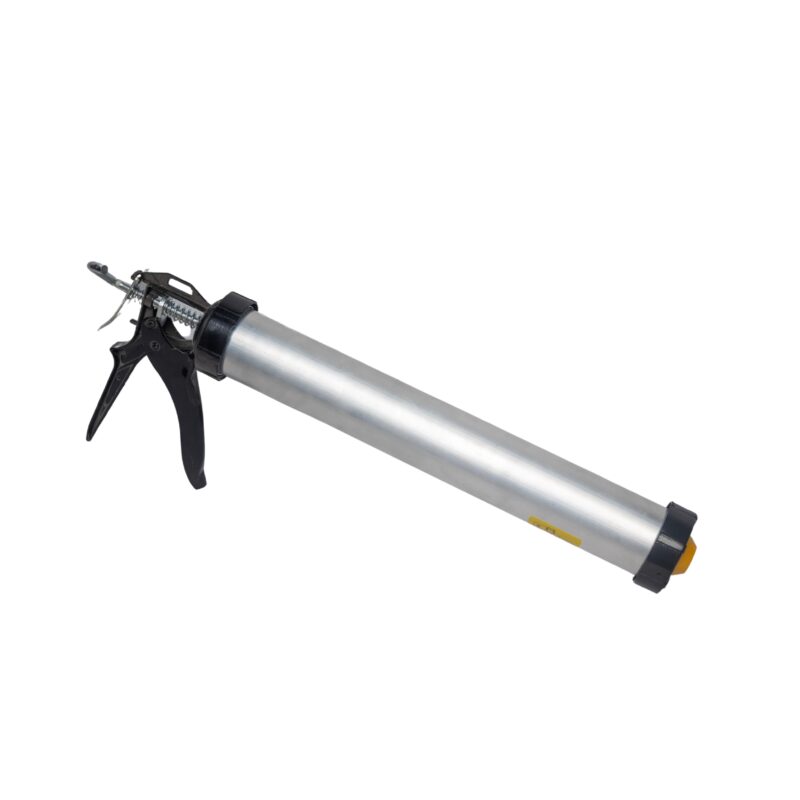
We supply manual and pneumatic sealant guns along with matching nozzles built to handle polysulfide and PU sealants used across highway joint sealing work.
What Is a Sealant Gun?
A sealant gun is a hand-operated or pneumatic tool that dispenses sealant into a prepared joint under controlled pressure, through a nozzle shaped to match the joint width and depth. On a road project, this is the tool that finishes the work started by a groove cutting blade and a groove cutting machine, delivering sealant into the cut groove in a steady, even bead instead of relying on a worker pouring sealant by hand and hoping it settles evenly.
The nozzle matters as much as the gun itself. A nozzle that is too wide wastes material and creates an uneven bead, while one that is too narrow slows the work down and risks leaving voids in the joint where the sealant did not fully fill the cut.
Why Proper Joint Sealing Matters
A joint that looks sealed and a joint that is actually sealed properly are not always the same thing. Water and debris that get into a poorly filled joint work their way down toward the dowel bar sleeve assembly below, accelerating corrosion and undermining the load transfer the joint was designed to provide in the first place. Near structures where an expansion joint board handles larger thermal movement, a poorly applied seal fails even faster under the extra movement the joint has to absorb.
A sealant gun that delivers a consistent, controlled bead is what stands between a joint that lasts the design life of the pavement and one that needs costly rework within a couple of years.
Manual vs Pneumatic Sealant Guns
Manual sealant guns work well for smaller jobs, patch repairs, and situations where a crew is sealing joints intermittently rather than continuously across a long stretch. They are simple, low-maintenance, and give the operator direct feel for how much pressure is going into each joint, which matters when working around crack repair sections that need a gentler, more controlled application.
Pneumatic sealant guns are built for volume. On a long highway stretch with hundreds of metres of joint to seal, a pneumatic gun keeps output consistent and reduces operator fatigue compared to squeezing a manual trigger all day. The tradeoff is the need for a compressed air supply on site, which is worth planning for alongside your separation membrane and other bulk material logistics before the sealing crew arrives.
Sealant Gun and Nozzle Specifications
| Type | Typical Use |
|---|---|
| Manual sealant gun | Small jobs, patch work, and low-volume sealing tasks |
| Pneumatic sealant gun | High-volume highway sealing and continuous joint work |
| Nozzle, matched to joint width | Controls bead width and depth for a consistent, clean fill |
Getting the nozzle size right for your joint width is not a detail to skip. A mismatched nozzle either wastes expensive sealant material or leaves the joint underfilled, and neither mistake shows up clearly until the joint is already under traffic and starting to fail.
Where Sealant Guns Fit in the Joint Sealing Sequence
Joint sealing is one of the last steps in the PQC construction sequence, and it depends on everything before it being done correctly. Grade and alignment start with a peg rod and string line, tensioned on a winch stand, well before the joint is even cut. Once the slab has cured and the joint has been saw-cut to the right depth, backer cord goes in first to control sealant depth, and only then does the sealant gun complete the sequence with a clean, properly proportioned bead.
Rushing straight to sealing without proper joint prep, or using the wrong nozzle for the job, undoes a lot of the precision that went into the earlier steps.
Site Practices for Sealant Gun Use
Clean, dry joints seal far better than joints sealed in a hurry over damp or dusty surfaces, so it is worth checking joint condition before the sealing crew starts, the same way you would check compaction after a screed vibrator or needle vibrator pass. Keep gun pressure consistent along the length of a joint to avoid an uneven bead that looks fine on the surface but varies in depth underneath.
Clean nozzles regularly during a long sealing run, since sealant that starts curing inside the nozzle restricts flow and leads to an inconsistent bead for the rest of the shift.
Why Choose Aspire Enterprises for Sealant Guns and Nozzles
We supply manual and pneumatic sealant guns along with matching nozzles, sized to handle the polysulphide and PU sealants commonly specified for PQC road joints. Sourcing your sealant application tools from the same supplier as your joint sealants keeps compatibility straightforward, without the trial and error of matching a gun from one vendor to a sealant from another.
We supply pan-India to highway contractors, EPC firms, and government construction departments, with the same bulk dispatch capacity available across our full products range and machines range.
Conclusion
A sealant gun is a small tool that decides whether months of careful joint cutting and backer cord installation actually pay off in a durable, watertight seal. Choose the right gun type and nozzle size, keep pressure consistent, and prepare joints properly before sealing, and the finished joint holds up for years of traffic and weather. Aspire Enterprises supplies manual and pneumatic sealant guns with matching nozzles, built for reliable performance on highway, expressway, and industrial paving projects.
Frequently Asked Questions
A sealant gun dispenses joint sealant from a cartridge or bulk container through a nozzle into a prepared joint. It is the tool that delivers the sealant cleanly and at controlled flow into PQC, expansion, construction, and structural joints.
A PU sealant gun is a manual gun used with polyurethane and polysulphide cartridges in standard joint sealing. A pneumatic sealant gun uses compressed air to dispense sealant, suiting long joint runs and high-viscosity sealants where manual triggering would be tiring.
The standard sizes supported are 300 ml and 600 ml cartridges, which cover the cartridges used by the common polysulphide, polyurethane, and silicone sealant brands.
Yes. The PU sealant gun and the pneumatic sealant gun are both compatible with polysulphide sealants used in PQC road and concrete joint sealing.
A sealant filling gun is loaded from a bulk container of sealant instead of a single cartridge. It suits large joint sealing programs where cartridge change time would slow the crew.
Yes. We supply standard, extension, and angled nozzles separately so crews can keep spare nozzles ready alongside the gun.
Yes. The same gun is used for silicone-filling gun applications. Choose the cartridge size and nozzle to match the silicone product.
Send the gun type (PU manual, pneumatic, or filling gun), the cartridge size, the nozzle quantity, and the project location through the inquiry form. The team confirms stock and dispatches the same business day.
RELATED BLOGS
Barricade Tape vs Caution Tape: What’s the Difference and Which One Does Your Site Need?
-
Posted by
marketingteam.aspire@gmail.com - 0 comments
How Properly Store of Road Construction Materials Improves Project Quality
-
Posted by
marketingteam.aspire@gmail.com - 0 comments
A Complete Guide to Estimating Materials for Concrete Road Projects
-
Posted by
marketingteam.aspire@gmail.com - 0 comments
How Weather Conditions Affect Concrete Road Construction and Material Performance
-
Posted by
marketingteam.aspire@gmail.com - 0 comments
Sustainable Road Construction: Materials and Practices for Modern Infrastructure
-
Posted by
marketingteam.aspire@gmail.com - 0 comments
Preventive Maintenance Tips for Road Construction Equipment
-
Posted by
marketingteam.aspire@gmail.com - 0 comments
How to Select the Right Construction Material Supplier in India
-
Posted by
marketingteam.aspire@gmail.com - 0 comments
Complete Checklist: PQC Road Construction Accessories Every Highway Contractor Needs on Site
-
Posted by
marketingteam.aspire@gmail.com - 0 comments
Concrete Road vs Bitumen Road in India: Which Lasts Longer and Which Costs Less to Maintain?
-
Posted by
marketingteam.aspire@gmail.com - 0 comments
Bharatmala Phase 2 in 2026: What PQC Accessories and Materials Are Required for NHAI Projects
-
Posted by
marketingteam.aspire@gmail.com - 0 comments
How to Cut Contraction Joints in PQC Roads: Timing, Depth, and Blade Selection Guide
-
Posted by
marketingteam.aspire@gmail.com - 0 comments
LDPE Sheet vs Polythene Sheet: Are They the Same or Different? A Buyer’s Guide for Road Projects
-
Posted by
marketingteam.aspire@gmail.com - 0 comments